
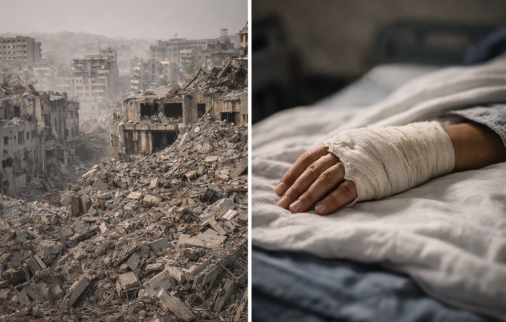
In Gaza, up to 68,000 injured could remain disabled due to lack of reconstructive surgery, Lancet study finds
- To understand the extent of the injuries in Gaza.
- To discover the challenges of the local health system.
- To become aware of the long-term consequences on survivors.
A study published in eClinicalMedicinegroup medical journal The Lancethighlights another tragedy than that of the deaths in Gaza: that of the survivors who are seriously mutilated, burned or disfigured, tens of thousands of whom require major reconstructive surgery to hope to return to a functional life. Since October 2023, the war has caused an explosion in the number of Palestinian civilian injuries, while paralyzing an already fragile health system, drastically reducing its capacity to provide specialized care.
More than 116,000 injured, a toll confirmed by modeling
Drawing on multi-source data including:
-
types of military attacks
-
population density
-
forced displacement
-
the progressive destruction of infrastructure
the researchers developed a statistical model intended to estimate the actual number of injured in the enclave.
Result: between October 7, 2023 and May 1, 2025, the study estimates the total number of injured in Gaza at 116,020 — a figure in line with the 118,014 injured reported by the Gaza Ministry of Health, thus corroborating the overall reliability of the available data despite the extreme collection conditions.
According to this modelling:
-
more than 80% of injuries are due to explosions
-
the majority occur during airstrikes or bombings
-
densely populated urban areas concentrate the majority of victims
Up to 46,000 people require surgical reconstruction
Among the injured identified, between 29,000 and 46,000 people would require reconstructive surgery, including:
-
treatment of severe burns
-
craniofacial reconstruction
-
repair of soft tissue injuries
-
or saving severely damaged limbs
If hostilities continue, researchers estimate that this figure could reach 34,000 to 68,000 patients by May 2026.
Even in a de-escalation scenario involving a 25% reduction in attacks, approximately 20,000 additional new injuries are anticipated in the coming year.
A health system unable to absorb the shock
However, before the war, Gaza only had eight certified plastic surgeons and no specialized training programs in surgical reconstruction.
Since the start of the offensive:
-
the majority of hospitals were damaged or destroyed
-
medical personnel were killed, injured or arrested
-
only a fraction of healthcare structures remains partially functional
Under these conditions, most reconstructive interventions — often long and complex — cannot be carried out.
The longer the time between the initial injury and surgical treatment, the more the risks increase:
-
infections
-
septicemia
-
permanent amputations
-
irreversible disabilities
A generation of survivors condemned to disability
Without a massive increase in local surgical capacities or medical evacuations, the authors estimate that tens of thousands of patients could remain with operable disabilities. Even if hospital infrastructure were restored to pre-war levels, the demand for reconstructive surgery would far exceed available capacity.
For researchers, humanitarian planning must now integrate not only emergency needs, but also the long-term care of survivors suffering from complex trauma. Finally, they remind us that, as long as the attacks continue, the number of injured — and therefore the need for surgical reconstruction — will inevitably continue to increase.
