
In memoriam. Professor Chems Eddine Chitour’s plea for authentic Islam
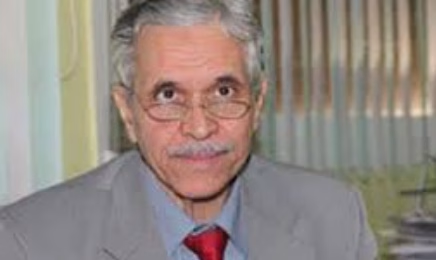
Professor Chems Eddine Chitoiur left us on April 19 after a long life devoted to teaching science as he understood it, that is to say a science open to the world and therefore to technology, a guarantee of sustainable development and true independence. But science as conceived by Professor Chems Eddine Chitour must also be inhabited by an incessant quest for meaning firmly anchored in Muslim ethics. This requirement is all the more imperative in the face of the challenges posed to humanity by the emergence of artificial intelligence, robotics and nanotechnologies.
I did not have the honor and pleasure of knowing Professor Chems Eddine Chitour personally but we crossed paths through our respective writings. I sometimes drew inspiration from his writings in my articles and he sometimes cited me in his articles with a kindness that forced my gratitude. Today, I think of the luck that the many students who worked with him during his decades of teaching both in the chemical engineering department at the National Polytechnic School of Algiers and at the Algerian Petroleum Institute had.
Not every day we have the chance to face a professor of great value who is at the same time inhabited by a breath which sends us towards the heavens of transcendence, ethics and a quasi-priesthood for the saving of the Earth and the salvation of humanity that the late Professor Chems Eddine Chitour only envisaged in a fierce fight against the “Money Theism” that a globalized neoliberal Order and cannibal seeks to impose on us.
The end of his teaching career was not for Professor Chitour a retirement, although well deserved, but a new beginning which he devoted entirely to awakening the consciences of the young generations alienated by the race behind the artificial symbols of a consumer society all the more infantilizing because it was entirely based on a rentier economy which expelled from the social horizon the work and intelligence which made the process of hominization possible.
Based on his experience as a scientist, Professor Chitour first sought to instill in his students this lesson that many scientists engaged in research and development structures in the pay of military-industrial complexes quickly forgot and that Montaigne summed up in his time in the simplest way: “Science without consciousness is only ruin of the soul”. To cultivate the search for meaning without which science is not safe from serious deviations, Professor Chitour had to confront the current issues of his time: robotics, nanotechnologies and artificial intelligence.
In another article devoted to nanotechnologies under the title “Nanotechnologies: fears, challenges and promises”, Professor Chitour warned us of the threat of extinction of the human species in the wake of anarchic development of nanotechnologies and concludes: “We are therefore warned. Should we, in the name of unbridled consumerism, allow humanity to engage unethically in the market? Has the time not come for a world government that respects the sustainability of humanity? »
In another article published on Oumma and with the evocative title: “The risks of deconstruction of humanity by unbridled artificial intelligence”, Professor Chitour warned us against the advent of a cyborg monster half man half machine if scientific research was left in the hands of laboratories in the pay of Capital without adequate ethical supervision: “The promises of science concerning the repaired Man and the augmented Man can, if they are not supervised by a ethical arsenal, lead to “the manufacturing of cyborgs that are half-man, half-machine, or even worse, the human creation of chimera that are half-man, half-animal. It appears that the genetic destruction of humanity for the benefit of a new humanoid species, where the mechanical dimension will be preponderant, would perhaps be one of the causes of the disappearance of humanity since it appeared 10,000 years ago.
In an article with pressing ecological accents under the title “Plea to save the earth”, Professor Chitour recalls this scientific truth completely ignored by capitalism in its frantic race for profit: “We must not forget that nature has spent more than two hundred million to hoard hydrocarbons and that man, in his delirium and his intoxication with power in the space of barely two centuries, thinks that he can with impunity disrupt the physical balances which have created hundreds of millions of years to bring about this climatic stability before the reign of the Anthropocene. It is urgent to stop this race towards the abyss.”
But to confront the ethical challenges posed by contemporary science as well as the immense challenge of climate change, Professor Chitour had to start from his own Muslim subjectivity. But for this, he had to courageously call on his co-religionists to emerge from their centuries-old lethargy and to find the lost thread of Nahda to which Emir Abdelkader, Jamal Eddine Al-Afghani, Mohammed Abdou, Mohammed Iqbal and Malek Bennabi called.
In an article with the evocative title “The fight against rukud in Islam: the contribution of Muslim thinkers”, he questions the capacity and will of humanity to reconnect with transcendence to escape the wanderings of the Market: “domesticated, regulated humanity, communing in the cult of the body, leads to an extraordinary waste; man has lost his truly human dimensions. Having become an anonymous personnel number, excessively computerized, his intellectual possibilities, his genome, his physical performance are the only parameters that cybernetized Society requires of him. His aptitude for generosity, his love of his neighbor, his metaphysical or religious questions do not come into play in his social ranking. Will man be able to overcome his materialistic dimension to move towards the absolute? “.
But the authentic Islam to which Professor Chitour called to reconnect with the transcendence which is one with the destiny of humanity is essentially spiritual in essence and therefore universal and open to the Other. In this regard, he did not hesitate to mobilize the Koranic verses and the texts of his classical and contemporary predecessors alongside the texts emanating from Pope Francis or the Dalai Lama in favor of peace and harmony between peoples against the speeches calling for hatred and the “clash of civilizations” which prepare the ground for the wars of the Neo-liberal Empire.
The spiritual Islam of Professor Chitour has nothing to do with the preppy Islam of those who would like to confine Islam to the private sphere or those who would like to detach it from the struggle of the multitude for self-determination and social and environmental justice with misleading slogans like that of “moderate Islam” concocted in the laboratories of the Empire and sung by the new service Muslims who squat the main stream media platforms. In an article with the revealing title “A new concept: moderate Islam”, Professor Chitour attempted to intelligently deconstruct this “moderate Islam” which served as a convenient cover for the Islamists of the Moroccan PJD when it was necessary to justify the signing of the Abraham Accords.
We will have understood it. The authentic Islam of Professor Chems Eddine Chitour is spiritual and interior in the sense that it opposes the hypocrisy and bigotry of ostentatious Islam which ignores the deep relationship to transcendence and the ethical duties of everyday life. An Islam that is open and tolerant towards Others, whoever they may be, but which orders Muslims to firmly fight Evil in all its forms (social injustices, occupation, wars.) at least through words when not through actions.
