
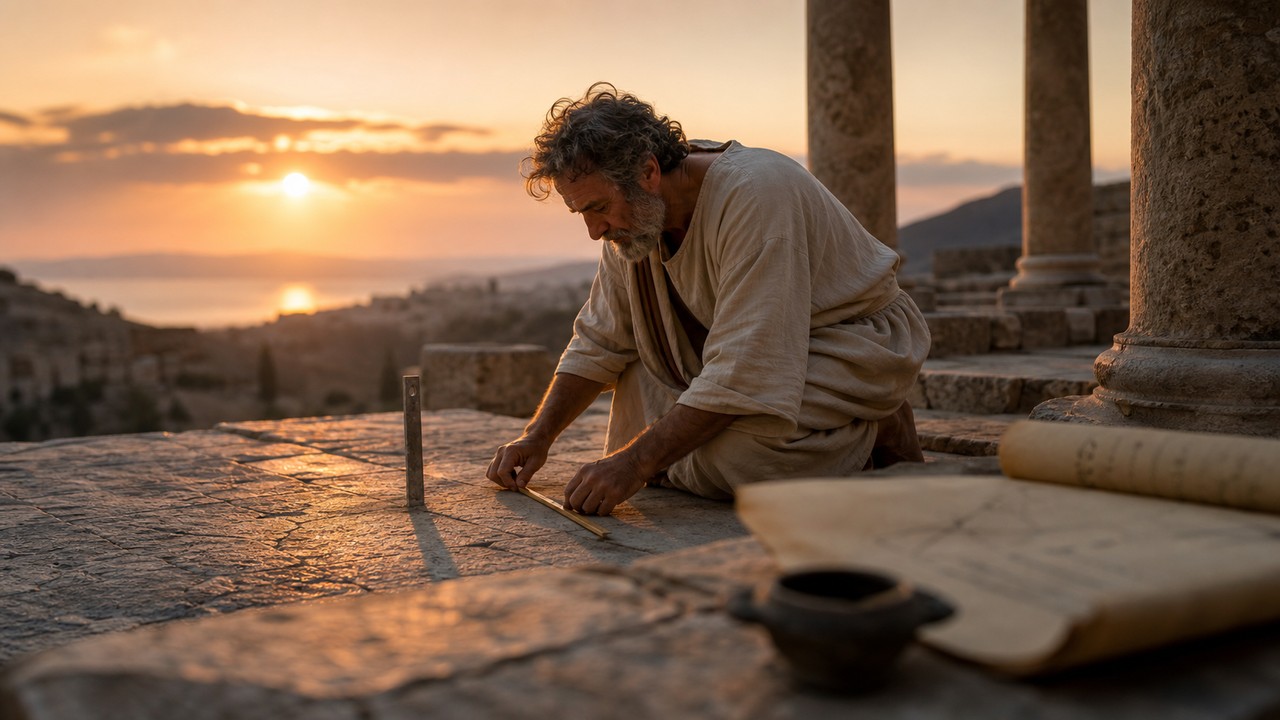
Long before modern technology these ancient astronomers calculated the size of the Earth with astonishing accuracy
Long before satellites, laser measurements and computer models, ancient thinkers were already trying to understand the size of the planet beneath their feet. What makes their work astonishing is not only the result, but the method: a mix of observation, geometry and patient reasoning that still feels remarkably modern.
The famous story often begins with shadows. By comparing the angle of sunlight in two different places, early astronomers realized they could turn a local observation into a planetary measurement. They did not need to see Earth from space. They needed a question, a distance and the courage to trust mathematics.
A simple shadow with a huge implication
The key idea was elegant. If the Sun was high overhead in one city at the same time it cast a measurable shadow in another, the difference could reveal the curve between the two points. Once that angle was known, the rest became a problem of proportion. A small slice of the globe could be used to infer the whole circumference.
This was not guesswork in the casual sense. It depended on assumptions, measurements and approximations, but the reasoning was solid. A historian of science might say: “The brilliance was not having perfect tools. It was knowing which imperfections still allowed a meaningful answer.”
Why the result still impresses scientists
Modern readers sometimes underestimate ancient science because it lacked modern instruments. Yet many early scholars worked with impressive discipline. They watched the sky across seasons, recorded patterns, debated errors and used geometry as a bridge between everyday experience and cosmic scale.
Their calculation of Earth’s size mattered because it changed humanity’s mental map. A planet with a measurable circumference is not a mythic surface. It is a physical object that can be studied, compared and navigated. That shift helped later astronomy, geography and exploration develop on firmer ground.
The power of asking the right question
The method remains memorable because it can be explained without advanced technology:
- observe the Sun’s angle in two places ;
- know the distance between those places ;
- use geometry to scale the arc to a full circle.
The simplicity hides a deeper achievement. Someone had to imagine Earth as curved, believe shadows could reveal that curvature and accept that a local measurement might speak for the whole planet. That is scientific imagination in its most practical form.
The lesson is not that ancient scholars knew everything. They did not. Their data could be rough, and their worldviews varied widely. But in this case, they showed how far careful thought can go when observation and mathematics work together. It is a reminder that technology accelerates discovery, but curiosity gives it direction.
A discovery built on shared knowledge
Such achievements rarely belong to one mind alone. Ancient astronomy developed through exchanges between observers, mathematicians, travelers and scholars who preserved earlier ideas. Measurements improved because people compared notes across cities, languages and generations. Science was already, in its own way, a collective memory.
That is why the story still matters in classrooms today. It shows that a profound result can begin with something ordinary, like a shadow on the ground. The wonder lies in noticing that the ordinary contains information, then building a careful argument from it instead of rushing toward a guess.
