
Ramadan 2027: dates for the start of fasting and Eid
In order to better understand the dates announced by the Muslim Theological Council of France (CTMF), here are some details concerning the visibility of the new lunar crescent.
1. The beginning of Ramadan : Monday February 8, 2027
The lunar conjunction will take place on Saturday, February 6, 2027 at 4:56 p.m. Paris time.
On that day, observing the new crescent will be impossible anywhere in the world, due to the insufficient time between conjunction and sunset.
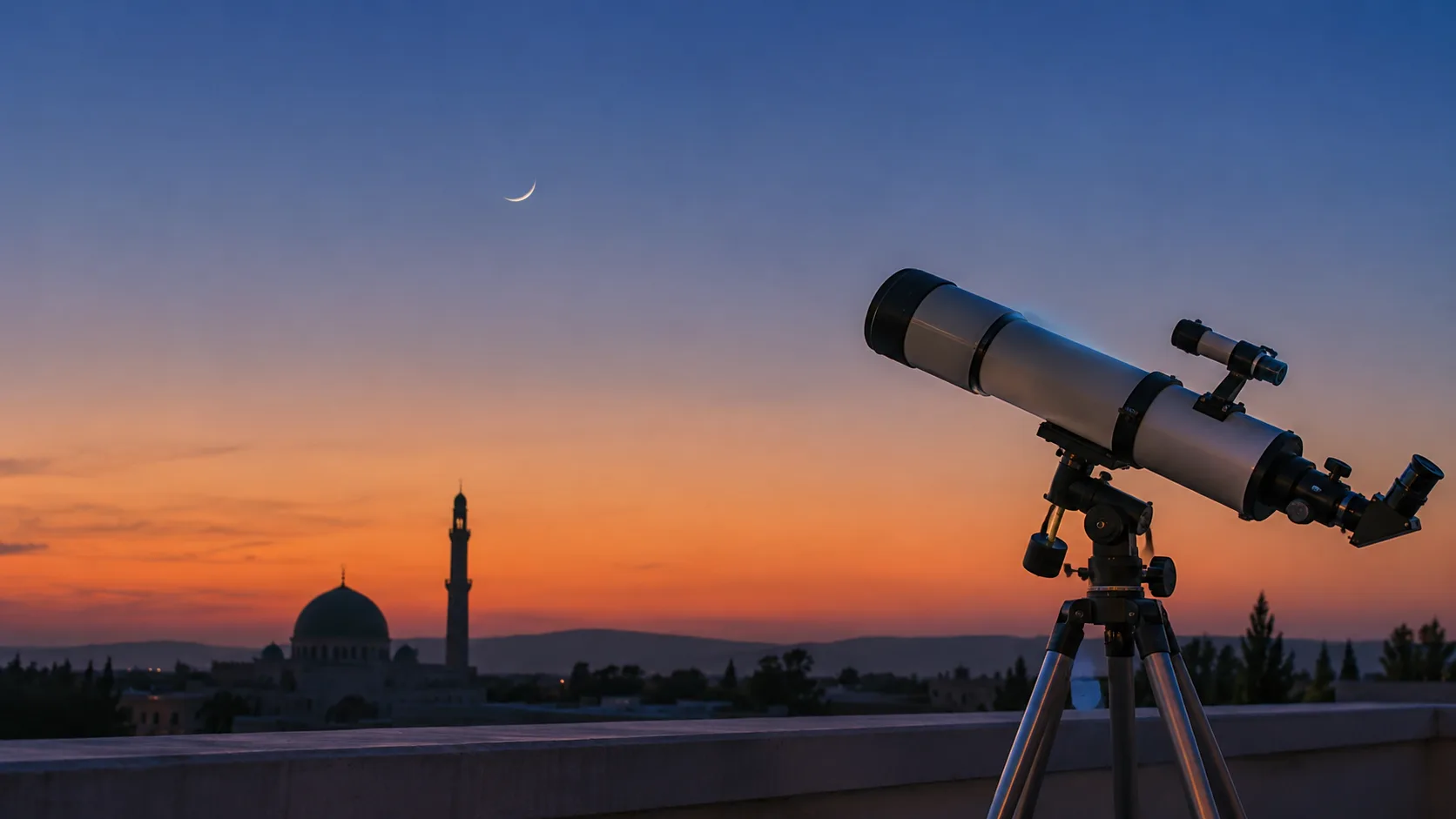
On the other hand, on Sunday February 7, the new crescent will be able to be observed in almost all Muslim countries, either using optical instruments such as the telescope, or directly with the naked eye, when weather conditions permit.
Towards a start of common fasting on February 8
Therefore, Monday February 8, 2027, announced by the CTMF as the first day of Ramadan, should coincide, insha Allah, with the start of fasting in a large number of Muslim countries, including those based on the observation of the lunar crescent.
We can therefore hope for broad convergence among Muslims regarding the start of Ramadan this year.
2. The end of Ramadan and the feast of Eid Al-Fitr : Tuesday March 9, 2027
The lunar conjunction will take place on Monday March 8, 2027 at 10:30 a.m. Paris time.
On that day, observation of the new crescent will not be possible in much of the world, including Asia, Europe, Africa and South America. On the other hand, it will be possible in certain regions of North America and the Pacific, either using a telescope or with the naked eye in the most favorable areas, when weather conditions permit.
Why Eid could be celebrated on March 9 or 10
Thus, Muslims who follow astronomical calculations based on the possibility of observing the crescent on a global scale will celebrate Eid Al-Fitr on Tuesday March 9, 2027, in accordance with the date announced by the CTMF and the calendars adopted in particular in Turkey and by several Muslim organizations in Europe and North America.
On the other hand, countries and communities that require local observation of the new crescent should complete the thirty days of Ramadan and celebrate Eid on Wednesday, March 10, since the crescent will not be observable in their areas on Monday, March 8.
It is nevertheless worth recalling several precedents concerning Saudi Arabia.
Since 2019, on several occasions, the Saudi authorities have announced the start of a new lunar month the day after the conjunction, in astronomical conditions comparable to those planned for March 8, 2027.
In Saudi Arabia, four precedents shed light on the date of Eid
In these situations, visibility of the new crescent was forecast mainly in parts of North America and the Pacific, at late hours in universal time, sometimes after midnight, or even around 3:42 UTC. Meanwhile, in Mecca, the Moon was setting only a few minutes after the Sun, in conditions astronomically incompatible with its observation even with a telescope.
Here are four previous ones (from the last 7 years):
- June 4, 2019 : first day of Shawwâl and Eid Al-Fitr, announced by Saudi Arabia.
- June 7, 2024 : first day of Dhul Hijjah, month of pilgrimage, on which the date of Eid Al-Adha depends.
- March 30, 2025 : first day of Shawwâl and feast of Eid Al-Fitr.
- February 18, 2026 : first day of the month of Ramadan.
In these four cases, the dates announced by Saudi Arabia coincided with those retained by the CTMF, despite officially different methods for determining the beginning of the lunar months.
It is obviously not a question of asserting that Saudi Arabia applies the same astronomical criteria as the CTMF or Turkey, but simply of noting this concordance on several occasions.
However, the astronomical conditions forecast for Monday March 8, 2027 are comparable to those of these precedents: in Mecca, the Moon will set approximately eight minutes after the Sun, with no astronomical possibility of observing the new crescent.
If an announcement similar to those in previous years were to occur again, Saudi Arabia and the communities that follow its decisions could also celebrate Eid Al-Fitr on Tuesday, March 9, 2027.
In this hypothesis, a very large majority of Muslims in France could celebrate Eid on the same day, insha Allah, while communities attached to the local observation of the crescent could choose Wednesday March 10.
Thus, a broad convergence around Tuesday March 9, 2027 remains possible insha Allah, without it being possible to prejudge the decisions that will be taken by the various religious authorities.
May Allah allow us to welcome this blessed month with unity and serenity.
Dr. Mohamed Najah
Member of the CTMF
