
“A Muslim named Jesus”: a book explores the figure of Christ in Islamic tradition
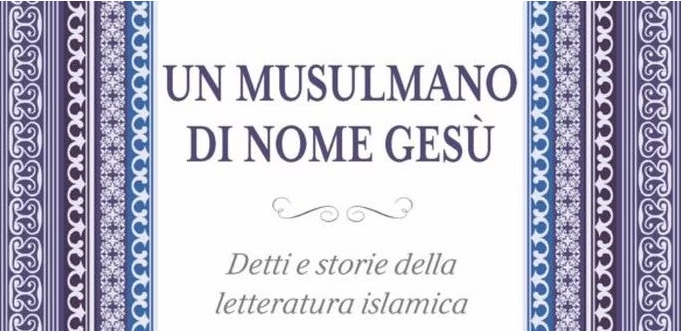
What if we reread Jesus through the eyes of Islam? It is the bet of the Palestinian historian Price Khalidi, professor emeritus in Beirut and Cambridge, whose work A Muslim di nome gesù has just been published in Italian by Terra Santa Edizioni. Already published in 2001 in Harvard, this book brings together an impressive anthology of stories and words attributed to Christ in pre-modern Islamic literature: a real mosaic of texts that the author describes as “Vangelo Muslim”.
These stories, scattered between Sufi treaties, collections of wisdom and stories of prophets, brush the portrait of a deeply human Jesus: a spiritual master, model of humility and compassion, which inspires by his maxims and his life as an ascetic. Far from the divine Christ of the Gospels, he is for Muslims a prophet, carrying a universal message, but also a central figure of the eschatological imagination, announced for the end of time.
The interest of Khalidi’s work is to show the richness of these traditions, sometimes close to the Gospels, sometimes completely original. We read familiar resonances there, like the echo of the sermon on the mountain, but also unpublished passages which testify to a spiritual creativity specific to the Muslim world. This anthology recalls that, in non -Christian literature, no other character has aroused as many stories as Jesus. In filigree, it is also an invitation to dialogue. By rediscovering Christ through Islamic memory, Khalidi opens a space for mutual understanding between Christians and Muslims. A bridge, fragile but necessary, in an era when religious misunderstandings still too often feed fractures.
The book also questions the way in which each religious tradition shapes its founding figures to meet its own spiritual needs. Where Christianity insists on the redemption by the cross, Islam highlights a wise, merciful and exemplary Jesus, a figure of social justice and hope. Two different looks, but which reveal the same desire to embody the divine in the human. Beyond theological research, A Muslim di nome gesù is an invitation to look at the shared history of monotheisms otherwise. He recalls that the meeting between traditions is not only played out in doctrinal debates, but also in stories, symbols and collective imaginations. So many spaces where the figure of Jesus continues, even today, to link instead of dividing.
This work also highlights a basic question: how the same religious figure can become a meeting place, but also of tension, between two spiritual universes. By retracing the diversity of the portraits of Jesus in Islamic tradition, Khalidi shows that dialogue between Christianity and Islam is not limited to abstract theological debates. He also involves the recognition of these crossed inheritances, where each religion says something of herself by speaking of the other. This is undoubtedly the strength of this essay: recall that the history of religions is made of mirrors, assumed differences but also common points which, if taken seriously, can nourish a mutual understanding.
