
A site leaves Muslims in media and political silence
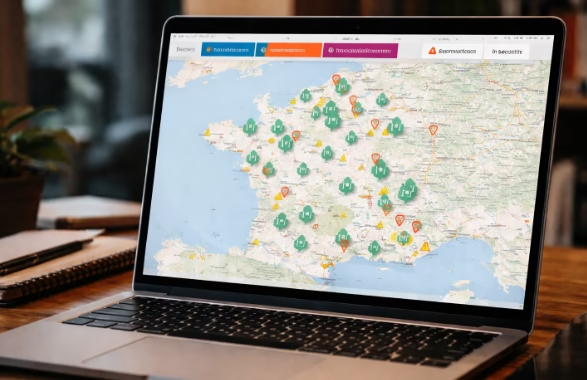
The “Where goes my France” site is not a simple marginal drift of the web. It is an accepted tool for designation and blacklisting, today examined by state services. Under the guise of “mapping French reality”, the platform lists mosques, migrant accommodation centers and working-class neighborhoods, while attaching to them indices of “Islamization”, “immigration” or “defrancization”. Behind this vocabulary intended to be factual, a reality emerges: the ideological registration of citizens because of their real or supposed religion. Processes which unambiguously recall methods historically associated with fascist regimes.
The affair broke out after the publication, at the beginning of January, of a message on the X network calling on Internet users to locate the mosque or the center for migrants closest to their home, presented as a “practical” tool for a future move. Alerted, the environmentalist deputy Sabrina Sebaihi contacted the Ministry of the Interior. Laurent Nuñez then asked its services to examine the file, without any firm decision having, at this stage, been made public.
A stigma machine with fascist overtones
This is in no way neutral data or an honest statistical exercise. The site constructs crude amalgamations between Islam, immigration and insecurity. Muslim places of worship, working-class neighborhoods and migrant reception structures are compared with raw crime figures, without method, without contextualization and without contradiction. Behind a supposedly neutral facade, the site functions as an ideological sorting tool. Maps and indicators are used to organize an assumed record of Muslims and racialized populations, in a logic of reporting typical of authoritarian and fascistic political cultures.. The “Islamization index”, based in particular on the number of Arab-Muslim first names, relates to practices comparable to ethnic statistics, although prohibited by law.
The objective is clear: designate areas to avoid, report populations as problematic and fuel a climate of fear. For Muslims, it is a digital target placed on the back, an ideological marking that transforms ordinary citizens into permanent suspects. To speak of a simple information tool here is a deception: it is an instrument of racist propaganda.
Few reactions to a serious deviation
Faced with this drift, SOS Racism announced its intention to file a complaint for public insult of a racist nature, incitement to hatred and discrimination. The association denounces a platform which trivializes Islamophobia and allows the dissemination of hateful remarks targeting people because of their religion or their real or supposed origin.
But the most striking remains elsewhere. Political reactions are rare, often timid. Media coverage of the case remains surprisingly low given the seriousness of the facts. As if the ideological profiling of Muslims no longer constituted a major scandal, but simple background noise in the political landscape. This silence is not neutral. It acts as an implicit validation of practices that fracture society and legitimize exclusion. Allowing this type of site to prosper means accepting that citizens are classified, located and designated as dangers. And it is, above all, trivializing the unacceptable.
