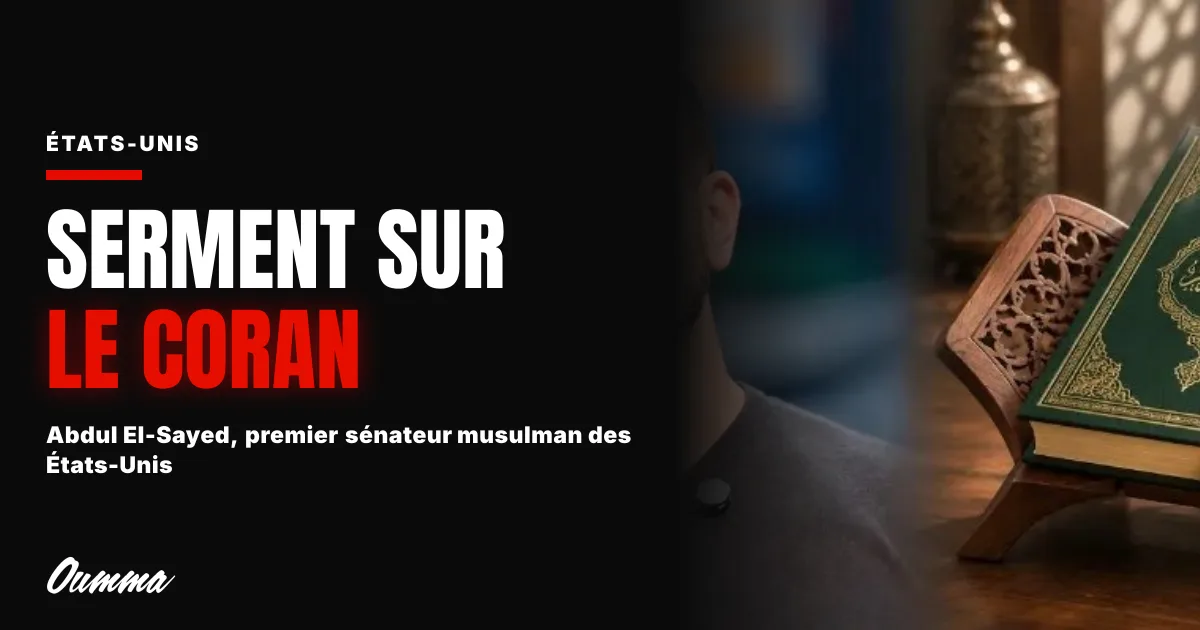
Abdul El-Sayed: oath on the Koran in the Senate
If the name Jefferson comes to him spontaneously, it is because another Muslim elected official has already borrowed the Koran from the third American president. On January 4, 2007, Keith Ellison, Democratic representative from Minnesota, was sworn in with his colleagues in the House of Representatives. For the individual ceremony that followed, in front of Nancy Pelosi, the first Muslim elected to Congress asked to place his hands on the two volumes that belonged to Jefferson. The photograph is making the rounds in the editorial offices.
We even know the place and year of purchase. In 1765, in Williamsburg, Virginia, Thomas Jefferson was studying law when he obtained an English translation of the Quran. The purchase appears in the register of the Virginia Gazette. Both volumes, translated from Arabic by George Sale, were printed in London the previous year. It would be another eleven years before Jefferson wrote the Declaration of Independence. Qur’an owned by Thomas Jefferson
Half a century later, after the burning of the Capitol by British troops, Jefferson sold nearly 6,500 works to Congress to replenish his library. His Quran is part of the lot. It survived another fire in 1851. This is how, two centuries after its purchase by a young law student, the book was able to be entrusted to an elected official from Minnesota on the day he entered Congress.
From Rashida Tlaib to Zohran Mamdani
On January 3, 2019, two women entered the House. Rashida Tlaib, elected from Michigan, wears an embroidered Palestinian dress. Ilhan Omar, elected representative from Minnesota, wears the hijab. The first Muslim women elected to Congress, both placed their hands on a Koran during their individual ceremony with Nancy Pelosi. The official oath has already taken place in the hemicycle, where the deputies pronounce it together.
In New York, on January 1, 2026, it was in a former subway station, under city hall, that Zohran Mamdani became the city’s first Muslim mayor. At midnight, two Korans accompany him. One belonged to his grandfather. The other, a small pocket manuscript dating from the late 18th or early 19th century, comes from the collection of Arturo Schomburg, a black Puerto Rican historian who dedicated his life to documenting the history of people of African descent.
For Abdul El-Sayed, it is perhaps in Michigan that the book of his future oath can be found. In the video, he describes the copy kept by the University of Michigan as “the first Quran in the state” and emphasizes its age. He still hesitates, he says, before returning to the only thing he wants to confirm at the end of the interview: “I will take an oath on the Koran. »
Subscribe to the Oumma letter: our articles, our analyzes and our new programs arrive directly in your mailbox.
Free. One-click unsubscribe. Everything you need to know about Umma’s letter
