
Ali Abderraziq (1888-1966), the thinker who dissociated religion and power
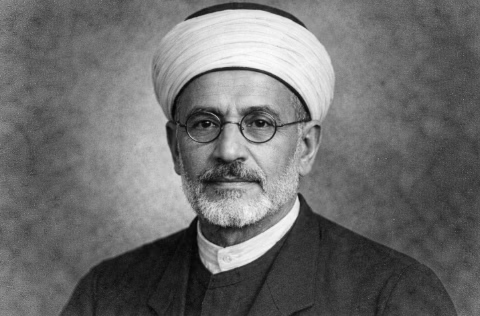
- Discover Ali Abderraziq’s thoughts on the relationship between Islam and politics.
- Understand the impact of his book on the perception of the caliphate.
- Explore the relevance of his ideas in the current context.
In the intellectual history of the contemporary Muslim world, Ali Abderraziq occupies a special place. Egyptian jurist and theologian, he is best known for a book published in 1925, Islam and the foundations of power (Al-Islam wa Usul al-Hukm). This work caused a lasting shock, because it calls into question a widely accepted idea: that according to which Islam imposes a precise political model, in particular the caliphate.
Ali Abderraziq was born in 1888 in Egypt, into a family of notables involved in political and intellectual life. He studied at Al-Azhar University, a center of Sunni religious knowledge, then trained in law. He serves as a religious judge (qadi), while developing personal reflection on the relationships between Islam, power and authority. After the condemnation of his book, he was excluded from official religious institutions. He nevertheless pursued a discreet intellectual career and died in 1966, without ever renouncing his positions.
The publication of his work comes at a time of great political and symbolic crisis. In 1924, the abolition of the Ottoman caliphate by Mustafa Kemal Atatürk caused deep unrest in the Muslim world. Many intellectuals and religious people then call for the restoration of this institution, seen as the pillar of Islamic unity. Ali Abderraziq takes the opposite view of this movement. He asserts that the caliphate is not a religious obligation and that no fundamental text of Islam imposes a precise form of government.
A clear and disturbing thesis
His reasoning is based on a simple but radical distinction. According to him, the Prophet Muhammad was above all a messenger responsible for transmitting a spiritual and moral message. The forms of power that appeared after his death are a matter of human choices, linked to specific historical contexts. Thus, politics does not relate to the sacred. It can and must be organized according to reason, the general interest and the will of the people, without being presented as a direct extension of religion. The religious authorities reacted strongly. In 1925, the Council of Great Ulemas of Al-Azhar condemned the book and dismissed Ali Abderraziq from his position. He becomes a marginalized figure, accused of weakening Islam. However, his critics struggle to refute his arguments on the theological level, so rigorous is his analysis of the sources.
A thought still current
Even today, Ali Abderraziq’s reflection remains very relevant today. Faced with attempts to sacralize political power in the name of Islam, his work reminds us that the confusion between faith and domination often produces injustice and violence. Without seeking to import a Western model, Ali Abderraziq laid the foundations of Muslim thought where religion rediscovers its ethical and spiritual dimension, freed from the influence of power. A courageous voice, always necessary in contemporary debates.
