
American bases in the Middle East: security factor or risk of regional escalation?
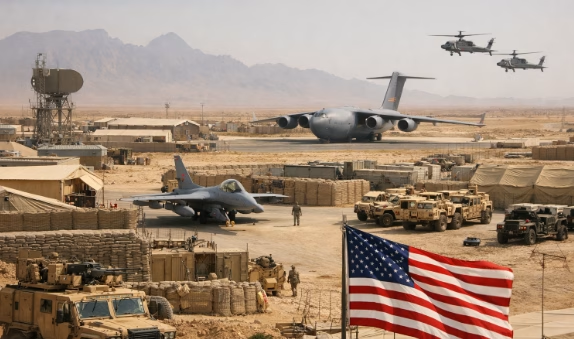
US bases in the Middle East raise questions about their role in regional security and geopolitical tensions.
WHY READ:
- Analysis of the consequences of the American military presence.
- Impact of rivalries between great powers on the region.
- Reflection on indirect conflicts involving Muslim states.
Iran was attacked by the American and Israeli armies, a fact widely reported in international news. In retaliation, Iran struck US bases located in several Arab countries in the Middle East. The Iranian authorities had also warned for a long time that in the event of a direct attack on their territory, they would retaliate against American interests in the region.
These strikes immediately raise a sensitive question: when American bases located in Arab countries are targeted, tensions then take on the appearance of a confrontation involving predominantly Muslim states. This situation fuels the impression of an indirect conflict where rivalries between great powers take place on territories belonging to the Muslim world.
In this context, the American military presence in the region deserves to be questioned. Do American bases really contribute to stabilizing the region or do they, on the contrary, contribute to increasing tensions?
The United States’ military presence in the Middle East is not new. For several decades, Washington has had major military installations in the Gulf. Al-Udeid Air Base in Qatar is one of the largest U.S. military installations outside the United States. The American Fifth Fleet is stationed in Bahrain, while Kuwait, the United Arab Emirates and Saudi Arabia also host military or logistical infrastructures.
Officially, these bases aim to guarantee regional security, protect United States allies and deter possible aggression. However, several Middle East specialists believe that this military architecture also contributes to transforming the region into a space of permanent confrontation between rival powers.
Analyst Ibrahim Fraihat, in an analysis published on Al Jazeera on January 14, 2020, already highlighted that American bases in the Middle East could constitute a lasting source of tensions and risks of escalation. According to him, the growing militarization of the region mechanically increases the probability that indirect conflicts will take place there.
Other Middle East specialists have also drawn attention to the strategic consequences of this military presence. Researcher F. Gregory Gause III explains that the states that host these bases can, despite themselves, find themselves on the front line in the rivalries between Washington and Tehran. For his part, political scientist Vali Nasr believes that any direct confrontation between the United States and Iran would have a strong chance of taking place in the territories where these military installations are present.
From this perspective, the question of the political and strategic cost of these bases also arises. The billions of dollars devoted to the defense of these infrastructures and the purchase of military equipment by certain Gulf States could, in the long term, be borne largely by these same countries.
More broadly, some critical analysts of international relations argue that military interventions by great powers are often linked to economic interests. Journalist and essayist Michel Collon thus maintains that conflicts led by great powers in certain regions of the world are frequently linked to the control of natural resources.
Several scholars have also pointed out that current rivalries in the Middle East are part of a broader geopolitical competition between great powers. Political scientist Vali Nasr explains in particular that the rivalry between Iran and Western powers is now part of a strategic restructuring also involving Russia and China, two actors who seek to limit American influence in certain regions of the world.
In this context, Moscow and Beijing maintain growing economic and strategic relations with Tehran, particularly in the areas of energy, trade and diplomatic cooperation. Without constituting a formal military alliance, these convergences of interests illustrate the existence of a broader balancing act between great powers.
Several Western intellectuals have also analyzed the destabilizing effects of international rivalries on certain regions of the world. The French historian and demographer Emmanuel Todd explained in particular that the interventions of the great powers can contribute to weakening the political and social balances of certain regions, sometimes aggravating already existing fractures.
In the same spirit, political scientist Gilbert Achcar analyzes the Middle East as a space marked by “proxy wars”, where rivalries between regional and international powers often result in indirect confrontations involving local actors. In this regard, some observers believe that the logic of preventive war invoked by the United States and Israel in the current conflict unfortunately seems to confirm this type of dynamic.
In such a context, some specialists warn of a risk: that of seeing global geopolitical tensions translate on the ground into confrontations mainly involving Muslim states. Such a scenario would then give the image of a religious or regional conflict, when in reality it would be deeply embedded in broader geopolitical rivalries – as has already been illustrated by the interventions and destabilizations which have profoundly transformed states like Iraq or Libya over the last decades.
It is precisely this danger that certain Muslim religious leaders and intellectuals have been highlighting for several years. Among them, Mirza Masroor Ahmad, spiritual leader of several million Muslims around the world, has repeatedly warned of the consequences of internal divisions within the Muslim world and of the risks of military escalation in the region.
The real question is therefore whether rivalries between great powers will continue to play out on Middle Eastern soil, at the risk of dragging the region’s societies into conflicts that go beyond their own interests.
