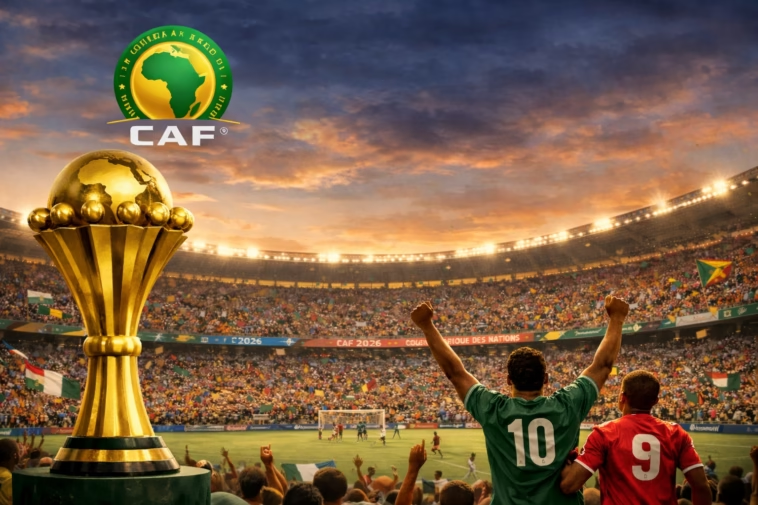
Behind the exhilaration of victory, the African Cup of Nations reveals logics of domination and division.
WHY READ:
- A reflection on football as a space of symbolic power in Africa.
- The dangers of heightened competition and social networks.
- The loss of fundamental values in sport.
Behind the spotlight of the African Cup of Nations and the exhilaration of victory lies a more bitter reality. Football, the last space of symbolic recognition for a continent marginalized on the international scene, in turn seems won over by the logic of domination, division and manipulation. A reflection on a sport which, by wanting to win, risks losing its soul.
On the international scene, African countries rarely have real political power. Marginalized in major global decisions and subject to power struggles dictated by the dominant powers, they struggle to make their voices heard on vital issues. Recent events, marked by bombings affecting the most vulnerable Palestinian populations for more than two years, provide a tragic illustration of this. It recalls the crushing weight of international power relations, as well as the virtual non-existence of the African voice in these major debates.
However, there is a space where Africa still manages to exist, to express itself and to assert itself: football. The most popular sport in the world, often perceived as a social opium, particularly for the most disadvantaged populations, it offers the continent a rare platform for international visibility and recognition. In Africa, football goes far beyond the simple framework of the game. It embodies a source of pride, a means of existing in the eyes of the world, a precious symbolic power in a context where other forms of power are largely lacking.
But this power, even symbolic, carries its own dangers. Because, paradoxically, in this space which should embody brotherhood and continental unity, we observe today the reproduction of the same logics of domination, division and confrontation which characterize global power relations. Deprived of real power on the international scene, Africans sometimes seem to reproduce among themselves, in the football arena, the patterns of which they are the first victims elsewhere.
The recent African Cup of Nations, organized in Morocco, provided a worrying illustration of this. Far from the image of a celebration of united and united African football, it revealed deep fractures, amplified by social networks and fueled by an obsession with results which seems to have relegated the essential to the background: the values which make football a universal language.
Winning on the field means existing in the eyes of the world, but also in the eyes of your neighbor. However, this symbolic power, precisely because it is one of the few available to Africa, becomes the subject of fierce competition which distorts its meaning. This sport, supposed to be a neutral space, above ideological divisions and struggles for influence, finds itself contaminated by logics of domination, calculation, manipulation and sometimes lies. What should have remained a game then becomes an issue of power.
The CAN: between spectacle and excesses
The African Cup of Nations, particularly during its edition organized in Morocco, offered a striking illustration of this. This great continental meeting, beyond the spectacle and popular enthusiasm, has sometimes revealed a more worrying reality. The pressure to win this competition is becoming more extreme than ever. When the goal of the trophy trumps everything else, certain attitudes inevitably resurface.
African football, despite its immense talent and human wealth, still struggles, and perhaps more than ever, to free itself from persistent reflexes: permanent suspicion, excessive protest and the desire to impose a result by all means. Added to this is blind support for a team, often to the detriment of a continental fraternity, or even a broader religious or human affiliation, although it is supposed to be unifying.
The era of social networks: amplifier of divisions
This problem has intensified in the era of social networks, where each match, each refereeing decision, each gesture of a player is immediately commented on, interpreted and amplified. Supporters of different teams confront each other in incessant debates, fueling controversies on digital “lives” where discussions, initially centered on football, quickly drift towards often extreme political positions.
The novelty lies in the fact that these controversies bring together, through a form of digital fraternity, individuals who sometimes do not even watch the matches and who, although very far from the football fields, feel concerned and often add a dose of venom. Football then becomes a simple pretext for social existence, much more than a real space for exchange around the game itself.
In this virtual space, existence now seems to be defined by permanent commentary and by taking an immediate, often martial, position. A way, for many, to escape the daily boredom in their respective countries and to take part in a continuous debate, with no real end. Everything is largely shaped by algorithms whose logic and intentions, deliberately opaque, are left to the reader’s discretion.
Disinformation, fake news, social slander and insults then emerge as ordinary weapons of debate, sometimes fueled by certain well-paid media actors who fuel these excesses for the purposes of visibility and buzz.
The loss of fundamental values
As Julius Caesar already summarized, it was enough to “give bread and circuses” to appease the crowds. This principle, originally thought to calm social tensions, has been profoundly transformed over time. Today, it no longer serves only to appease, but sometimes to fragment, to erect symbolic barriers and to prevent a real union between peoples, a union that is more vital than ever in an international context where the powerful seek the slightest breach to perpetuate disorder and impose their influence.
Through excesses, African football seems to have lost, even more so in the digital age, the very meaning of its existence. He has forgotten his fundamental values: fraternity between peoples, respect for the adversary, equity, fair play, humility in victory as well as in defeat, solidarity and the joy of the shared game. These principles, which made football a universal language, are today relegated to the background, crushed by the obsession with results and controversy.
Even more serious, certain postures observed are dangerously reminiscent of authoritarian behavior. Without having real political or economic power, certain actors, organizers, players, referees or spectators, reproduce in the sporting context the same patterns as those observed elsewhere: refusal of contradiction, desire to impose one’s truth to the detriment of the rules of the game, obsession with control and results, even if it means being right even when everything indicates the opposite. The African Cup then becomes, in places, a worrying imitation of power, a simulacrum of domination, even without real power.
We are thus witnessing, perhaps for the first time, an African Cup without soul, without clear benchmarks, without a real moral compass. A competition where winning seems to justify everything. An African Cup which, by dint of moving away from its initial spirit, ends up questioning its own legitimacy: can we still speak of a football festival when values disappear?
The African Cup should not be that. It shouldn’t exist at that price. Because football without values is nothing more than an empty spectacle, a theater of frustrations and tensions, a reflection of the faults that we refuse to face collectively. As long as victory takes precedence over ethics, as long as the trophy is worth more than the spirit of the game and fraternity, African football will continue to betray itself, further weakened by social networks and algorithmic logic.
Ultimately, the question remains heavy and worrying: to win the African Cup, at what cost? Because behind a victorious team in the final, it is sometimes an entire continent with a billion and a half souls, already tested by profound economic and social difficulties, which seems to move a little further away from what made it strong: collective sense, the values of fraternity and unity. A silent alert, which goes far beyond the framework of football and questions the very future of African living together.