
Arrest warrant against Netanyahu: sanction against French judge Guillou
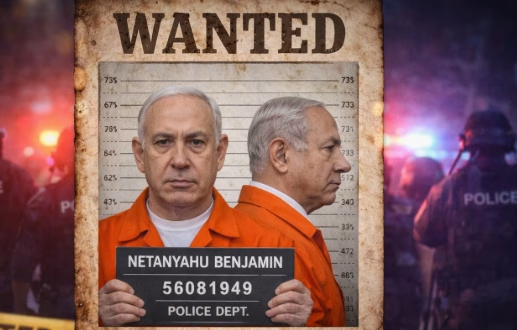
- Understand the implications of the sanction on international justice.
- Analyze Donald Trump’s role in this situation.
- Consider the consequences for the law-based world order.
The sanction imposed on French magistrate Nicolas Guillou after the arrest warrant issued by the International Criminal Court against Benjamin Netanyahu marks a worrying — and deeply scandalous — turning point in the recent history of international relations. In an interview given on France 5the judge describes a situation worthy of a digital ban: “I discovered that almost all payment methods in France are American. My card no longer works. It was disconnected… I can no longer order on Amazon, or book an Airbnb… even Booking or Expedia block my transactions. We go back 30 years. »
“My credit card has been cut. Nothing works anymore”: French magistrate Nicolas Guillou sanctioned after the warrant issued by the International Criminal Court against Benjamin Netanyahu. pic.twitter.com/kqcdu1WSj9
— Oumma.com (@oumma) March 22, 2026
In other words, a European magistrate finds himself suddenly deprived of all normal economic life – not for a fault, but for having carried out his mission within the framework of international law. Behind this decision, the responsibility of Donald Trump is overwhelming. This retaliatory measure, of rare brutality, illustrates a dangerous drift: the use of American economic power as a political weapon to protect Israel’s interests. An assumed pressure, which openly tramples on the independence of international justice.
The situation is all the more revolting as it reveals a total inversion of values. While Benjamin Netanyahu is accused of extremely serious crimes — that many NGOs, authorities of theUnited Nations as historians, including Israeli ones, describe as genocide — it is those who participate in the implementation of international law who find themselves sanctioned.
In the world we live in today, requesting an arrest warrant against a leader suspected of such crimes no longer leads to advancing justice, but to being punished, isolated, and ostracized. The magistrate pays the price for his courage, while the alleged perpetrator remains protected. The judge’s testimony is clear: “If prosecutors are afraid to prosecute, if lawyers are afraid to defend, if judges are afraid to judge… then there is no longer democracy. We act out of fear. »
This logic is deeply perverse. It marks a worrying collapse: that of an international order supposed to be based on law, equity and responsibility. Instead, we see the establishment of a political hierarchy where certain leaders seem untouchable, and where justice becomes conditional. Beyond the case of Nicolas Guillou, a red line has been crossed. If international justice can be neutralized in this way by economic sanctions, then it is nothing more than a simulacrum. And with it, the very idea of a world order based on law is tottering.
“My credit card has been cut. Nothing works anymore”: French magistrate Nicolas Guillou sanctioned after the warrant issued by the International Criminal Court against Benjamin Netanyahu. pic.twitter.com/kqcdu1WSj9
— Oumma.com (@oumma) March 22, 2026
