
At the University of Versailles, censorship hits Pascal Boniface: can we still debate Israel-Palestine in France?
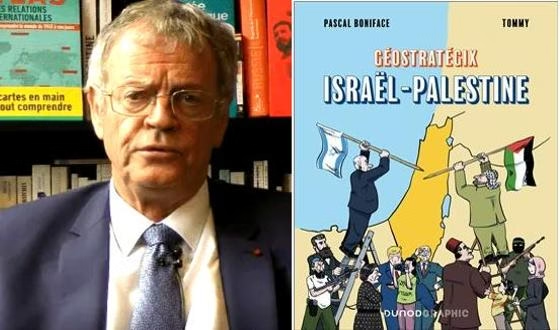
The roundtable on Israel-Palestine at the University of Versailles has been canceled, raising questions about censorship and freedom of expression in France.
WHY READ:
- Understand the issues of censorship in academic debate.
- Analyze the impact of the cancellation on freedom of expression.
- Reflect on the place of the Israeli-Palestinian conflict in public discourse.
The news is astonishing. The round table “Israel-Palestine: an endless war? », which was to be held on March 19 at the University of Versailles Saint-Quentin as part of the 2nd edition of the university comics festival The Cry of the Bubblewas simply canceled. The guest? Pascal Bonifacedirector of IRIS, recognized specialist in international relations, on the occasion of the publication of the comic strip Géostratégix: Israel-Palestinecreated with the designer Tommy and published by Editions Dunod.
A unilateral and opaque decision
According to the message sent to the organizers, the president of the University of Versailles Saint-Quentin, Loïc Josserandecided to cancel the meeting “for reasons of public order”. This decision was taken without consultation with the organizing committee, the founders or the festival programmer. She intervened without the president deeming it necessary to warn the authors of the comic strip in order to explain his decision to them.
Even more serious: this is the only round table whose deletion has been requested.
In other words, the problem would not be the event itself, but rather its subject – and the authors of this comic strip. Beyond the theme addressed, it is now those who try to offer a geopolitical, educational or simply informed reading who become the real targets of cancellation.
Israel-Palestine: a debate that has become impossible?
What does the “public order” argument mean today when it is invoked to prevent academic discussion? Since when does a supervised debate, in a university, with a recognized specialist, constitute a threat? The question is no longer marginal. It is central. It has become almost impossible to calmly debate the Israeli-Palestinian conflict in France. The simple fact of wanting to analyze, contextualize, historicize now exposes one to suspicion. Any attempt at geopolitical perspective is immediately disqualified. Any desire to go beyond emotion and slogans to enter into reflection is seen as a suspicious position.
We are no longer in democratic disagreement, but facing real censorship. A direct attack on freedom of expression which does not speak its name. Even as the Israeli-Palestinian conflict upsets the balance of the Middle East and weighs heavily on international relations, the French public space is closing down. Instead of organizing the debate, we prevent it. Instead of confronting the analyses, we disqualify the participants.
This drift is part of a worrying climate: that of a society where those who simply want to exercise their right to debate are dissuaded, stigmatized and marginalized. We are witnessing the installation of an informal but formidably effective system where the anticipation of scandal replaces debate, where the fear of accusations is enough to silence dissonant voices, and where the preventive invocation of disturbance of public order becomes the instrument of intellectual sidelining. It is no longer just a question of controversializing ideas, but of preventing them from being exposed – a logic which is akin to a harsh neo-McCarthyism, installed under the guise of public order and based on the fear of speaking.
Even though Pascal Boniface is censored
It is difficult to suspect Pascal Boniface of being an agitator or an extremist. Recognized geopolitologist, author of numerous works, he embodies a structured and argued academic voice. And yet. Even a personality known for his expertise and his educational work today finds himself prevented from debating in a university setting.
If even a scholar of this stature is prevented from speaking on a field he has studied and taught for decades, a serious conclusion must be drawn: no one is truly free to speak anymore, except those who agree with the official line. What happened at Versailles is not a simple administrative cancellation: it is an assumed political decision, which reveals a climate where prudence serves as a cover for censorship. It establishes the idea that certain subjects should now be excluded from public debate, including in places supposed to defend intellectual freedom and the demand for critical thinking.
As certain words become impossible to pronounce and certain analyzes are disqualified, the scope of what is permitted to be said is reduced. This movement recalls the Newspeak imagined by Orwell in 1984. It is no longer just an event that we are cancelling, it is the very possibility of thinking freely, and of debating without intimidation that we are seeking to silence.
The university, space of knowledge or zone under surveillance?
The university is not a neutral place void of tensions. It is, by nature, a space for the confrontation of ideas. Refusing the debate in the name of a hypothetical disorder, without a demonstrated public element, amounts to enacting a form of institutional self-censorship.
By anticipating controversies, we end up institutionalizing them. By dreading the debate, we suppress it. The consequence is serious: we nourish the idea that the Israeli-Palestinian conflict has become a taboo subject. Which should be avoided, circumvented or ousted. We may not agree with all of Pascal Boniface’s analyses. We can discuss our positions, contest them, criticize them. This is the very principle of intellectual debate. But preventing discussion is not debating.
Academic freedom is not only defended when ideas are consensual. It defends itself precisely when the climate is tense, when passions are high, when the subject is disturbing. The cancellation of this round table is unfortunately not an isolated case. It is part of a dynamic that is now well established: that of a constant shrinking of the space for debate when it comes to the Israeli-Palestinian conflict. Conferences canceled, interventions canceled, speeches hampered… The phenomenon no longer spares anyone. Even recognized specialists. Even academics. Even when it comes to an educational approach through a comic strip.
And too often, the accusation of anti-Semitism hovers in the background, brandished like a weapon of mass disqualification. Criticism of a state or government policy is considered anti-Semitism. Geopolitical analysis is suspected of ulterior motives. The debate becomes a trial of intent. This continued confusion is dangerous. It trivializes the most serious accusations, weakens the real fight against anti-Semitism and transforms political discussion into a minefield. If debate disappears from universities, where can it still exist?
