
Auction in London: treasures of Islamic art at Christie’s
Christie’s, one of the major international auction houses, founded in London in 1766, will organize a sale on November 12 dedicated to the arts of the Islamic and Indian worlds. Illustrated manuscripts, jewelry and ancient carpets will rub shoulders with rare pieces from Egypt, the Caucasus and the Indian subcontinent.
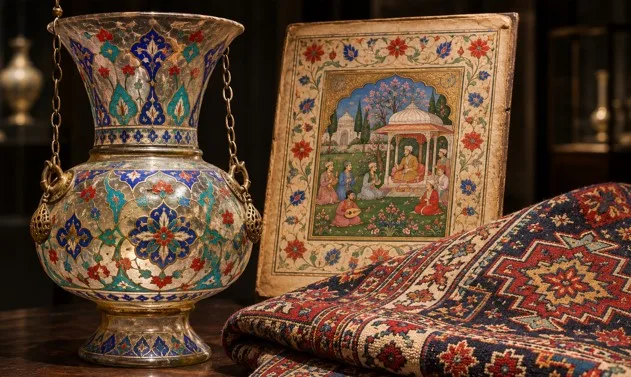
Highlights include the upper part of a 14th-century Mamluk mosque lamp, linked to the Sultan Hassan complex in Cairo. This enameled glass fragment, which testifies to the know-how of the artisans of the time, is estimated between 240,000 and 360,000 euros.
The sale will also include eleven sheets of Zafarnamaor “Book of Victories”, commissioned by the Mughal emperor Akbar in the late 16th century. Their illustrations retrace the life of Tamerlane, between battles, political meetings and construction of monuments.
A “dragon” carpet from the Caucasus, dating from the end of the 17th or beginning of the 18th century, recalls the exchanges between cultures. Its motifs, of Chinese origin, traveled along the Silk Road before being reinterpreted by local weavers. It is estimated between 120,000 and 180,000 euros. Three gold necklaces set with stones, from southern India, will also be offered. Acquired by American collector Adeline Pepper Gibson during her honeymoon in 1912, they have remained in her family since her death. Two of these jewels are each estimated between 24,000 and 36,000 euros.
Another remarkable piece: a small Kashmir rug, made at the end of the 19th or beginning of the 20th century. Woven in pashmina wool on a silk structure, it has more than 2.5 million knots. This work of great finesse is estimated between 9,600 and 14,400 euros.
Beyond the prices, this sale reminds us that the arts of the Islamic world were nourished by encounters and circulation, from China to the Mediterranean. The passage of these works between private collections also raises the question of their access to the public: their value is not only due to their rarity, but to the history that they allow to be transmitted.
