
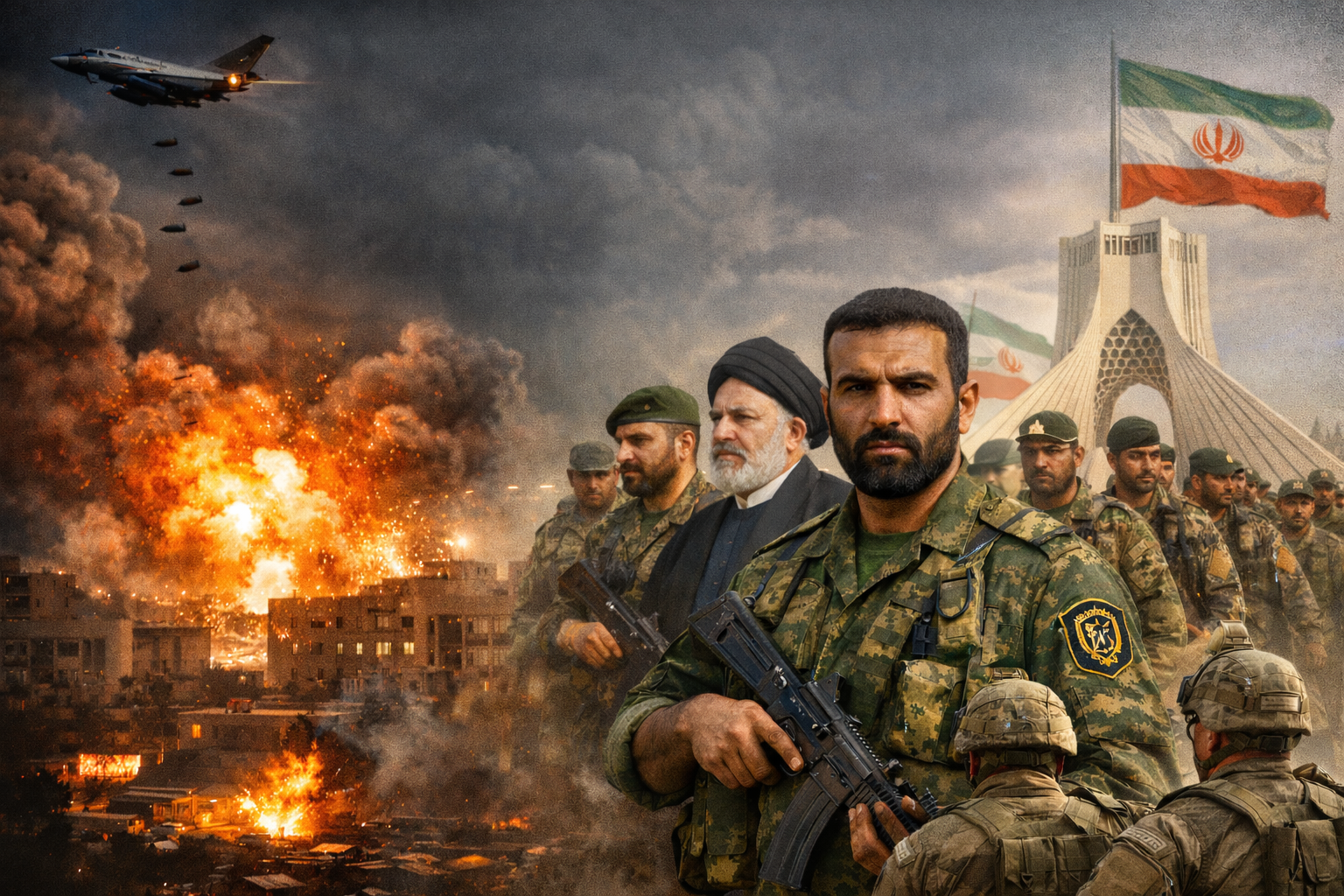
Can we overthrow the Iranian regime with air strikes alone?
For several years, the idea has come up repeatedly in certain Western political circles: massive airstrikes could be enough to falter, or even overthrow, the Iranian regime. The hypothesis is attractive for its simplicity. It promises strategic change without land engagement, without prolonged occupation and without military stagnation. However, contemporary history shows that a structured regime almost never falls under bombing alone.
A rational analysis therefore requires going beyond slogans. Airstrikes can weaken a military apparatus, destroy infrastructure, disrupt chains of command. But they do not replace either control of the field or the recomposition of political power.
The structural limits of “all aerial”
A regime is not just about military bases or strategic sites. It is based on a system: armed forces, security services, administrative institutions, ideological relays, networks of allegiance. Destroying infrastructure does not equate to dissolving this system.
The experience of past conflicts illustrates this: without a ground presence to occupy urban centers, sustainably neutralize loyalist forces and supervise the political transition, bombings rarely produce the immediate collapse of power.
Furthermore, the exclusive use of airstrikes carries a paradoxical risk: that of strengthening the internal cohesion of the targeted regime. History shows that in the face of external aggression, even societies experiencing deep tensions can temporarily rally around the power in place in the name of national sovereignty. Bombings, far from causing an immediate collapse, can fuel a reflex of resistance, legitimize the security rhetoric of the authorities and marginalize internal opposition, accused of weakness or collusion with the enemy.
Finally, the “all-air” approach suffers from a major strategic limitation: it never resolves the question of what comes next. Destroying is one thing, rebuilding a political order is another. Without a credible actor to ensure the transition, without a force capable of stabilizing the ground and preventing power struggles, the vacuum created by the strikes can lead to chaos rather than change. A weakened but not replaced state can become a source of lasting instability — a prospect that, far from serving Western strategic interests, could on the contrary undermine them.
Iran: a structured state
Iran is neither a failed state nor an isolated power entrenched in a presidential palace. The regime relies on a dense and deeply rooted institutional architecture: the Revolutionary Guards (IRGC), structured internal security forces covering the entire territory, a centralized judicial and administrative apparatus, an influential ideological and religious network, as well as a real social base, whether of membership or interest.
Bringing down such a regime is therefore not a simple one-off military weakening. This would involve neutralizing its armed forces, dislocating its security apparatus, sustainably controlling large urban centers and ensuring a credible institutional transition. In other words, it’s not just about hitting infrastructure, but about dismantling an entire political system — something no single bombing campaign can accomplish.
The political cost of ground intervention
Added to this strategic reality is a major political constraint on the American side. A ground operation in Iran would involve potentially high casualties in the face of a large army, battle-hardened paramilitary forces and a vast and rugged territory. The commitment would be heavy, prolonged, uncertain.
However, American public opinion remains deeply marked by the Iraqi and Afghan experiences. The losses on the ground, the long and costly wars, the billions swallowed up in conflicts without a clear outcome have left a lasting mark on the internal debate.
For Donald Trump and its electoral base, who advocate strategic firmness but reject “endless wars”, a land escalation would risk becoming politically explosive. As electoral deadlines approach, notably the mid-term elections, the opening of a major front in the Middle East could divide the conservative camp, mobilize the Democratic opposition and transform a demonstration of power into an electoral burden.
Bombing is not governing
The fall of a regime generally occurs in three cases: a total military defeat accompanied by an occupation of the territory, a massive and lasting internal uprising, or a combination of the two. Air strikes can create pressure, weaken a power, modify a balance of power – but they are not enough to organize the aftermath. To think that a regime as structured as that of Iran could collapse solely under bombs is more a political gamble than a strategic analysis. The question is not only military: it is institutional, territorial and political.
Ultimately, recent history calls for caution. You can weaken a state from the air. We cannot replace it without a presence on the ground.
