
Controversy: Human Appeal USA paid more than $2 million in commissions to a fundraiser
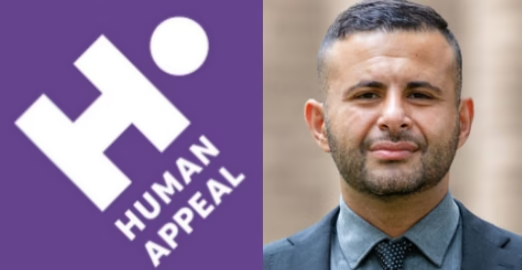
What began as a demand for transparency turned into a heated controversy on social networks in UNITED STATESdirectly calling into question Human Appeal. The case relies on U.S. tax documents and also involves Khaled Beydounan academic and activist based in the United States, accused by some civil society actors of having personally benefited from fundraising for humanitarian causes, particularly in Gaza. The figures revealed and the NGO’s communication have since triggered a broader debate on transparency, ethics and responsibility in humanitarian work.
Tax documents that raise questions
The controversy hinges on US tax documents called Form 990which nonprofit organizations must publish annually. According to the database of ProPublicathe NGO indicates that Khaled Beydoun would have raised more than $7.1 million in 2024 thanks to online campaigns.
In these same documents, a sum of more than $2 million appears as payment for “professional fundraising services,” or nearly 29% of the total raised (or more than $7 million). These figures, made public, quickly circulated on social networks and raised many questions about the actual use of the donations.
Following the controversy, Human Appeal USA acknowledged that an interim US tax form (Form 990) contained errors, citing an administrative error currently being corrected in collaboration with external auditors. The organization specifies that the people responsible for these tax declarations in 2024 are no longer part of its teams and affirms that it has taken all necessary measures to guarantee the compliance, accuracy and transparency of its financial documents. She also maintains that the funds collected for humanitarian projects were allocated to the causes announced.
The accusations and defense of Khaled Beydoun
The collective Wear The Peacecommitted to questions of ethics and responsibility of NGOs, publicly challenged Beydoun. According to Human Appeal, the collections were presented as emergency aid for Gaza and other humanitarian crises, which could have led donors to believe that all of the money would go directly to helping people.
Khaled Beydoun categorically rejects these accusations. He claims to have never received any money personally and cites an administrative error in tax declarations. According to him, Human Appeal put its name in place of that of a non-profit organization which actually received the funds. He says he has renounced all remuneration and explains that the money would have been used to finance actions to combat Islamophobia. He also specifies that the campaigns concerned several humanitarian crises, notably in Gaza, but also in Yemen, Pakistan and Lebanon.
hey @KhaledBeydoun why were you paid $2,040,887 to fundraise for Human Appeal (501c3) for Gaza initiatives in 2024?
(A thread)
— WearThePeace (@WearThePeaceCo) February 5, 2026
Human Appeal under critical scrutiny
In this case, the organization also finds itself under pressure, even if no formal accusation of illegality has been announced. She is directly concerned, because it is her own tax declarations which mention the disputed payment. For many observers, if an administrative error was really made, it should have been officially corrected in order to avoid any ambiguity and to reassure donors.
Practices deemed problematic by industry experts
Several independent experts from the humanitarian sector say they are concerned by the amounts revealed in this affair. According to them, a remuneration rate close to 30% of the sums collected is out of step with the ethical standards usually expected in the context of calls for donations linked to humanitarian emergencies, in particular when it comes to major crises like Gaza. While they point out that the costs associated with fundraising can be legitimate, these experts emphasize that a lack of clear transparency to donors on the actual allocation of funds poses a major problem. They also believe that the public was not sufficiently informed of the fact that significant portions of donations could finance structures or activities outside of direct humanitarian operations.
Finally, they call for stricter supervision of the use of professional influencers and collectors, recalling that NGOs, unlike commercial companies, must prioritize their humanitarian mission and the interests of beneficiaries over any logic comparable to a commission model.
At this point, no official investigation has been made public. However, the controversy weakens the image of Human Appeal and rekindles the debate on the financial transparency of large humanitarian organizations, particularly when they rely on highly visible personalities on social networks to raise funds in times of crisis.
Human Appeal: contested neutrality in the face of Gaza
The criticism is not just about the numbers. The organization’s communication is also strongly questioned. Activists and donors criticize Human Appeal (including Human Appeal France)when calling for donations for Gaza, to adopt very neutral language, without ever naming Israel or using the term “genocide”.
This posture contrasts sharply with that of Médecins Sans Frontières, which openly describes the reality of violence, going so far as to use the term “genocide”and clearly names responsibilities. For many critics, this neutrality is morally untenable: we cannot be neutral in the face of genocide, and refusing to name things amounts to mitigating their seriousness. This choice of communication reinforces the unease around the NGO and fuels the idea of a gap between its calls for donations and the reality experienced by civilians in Gaza.
A question of trust for donors
Beyond the amounts and declarations, this case raises a central question: that of trust. Did donors have all the information they needed to understand exactly where their money was going and how it was being used? Even in the absence of proven personal enrichment, the lack of clarity on the use of funds and on the discourse adopted can permanently undermine the credibility of humanitarian actors.
In the absence of amended tax documents and clear, verifiable and public answers, the controversy remains unresolved. It illustrates a growing tension between activist engagement, influence on social networks and the demand for transparency in humanitarian action — a tension which, for the moment, remains unresolved.
