
Equality between women and men in Islam: what the Koran and history really say
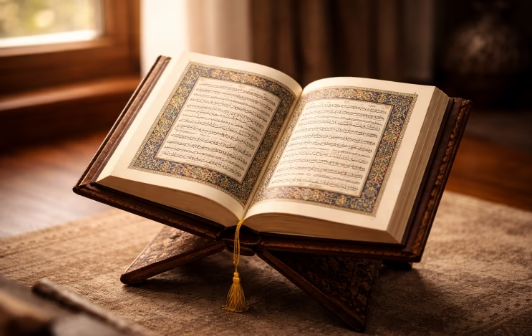
Islam is often seen as a religion that places men above women. This very widespread idea, however, is based more on cultural practices and rigid interpretations than on the founding texts themselves. A simple and honest reading of the Koran, as well as a look at the beginnings of Muslim history, show on the contrary that Islam affirms a fundamental equality between women and men, particularly on the spiritual, moral and human levels.
Equality from creation
The Koran begins by recalling that all human beings have the same origin: “O men! Fear your Lord, who created you from one being, and created from it his spouse” (Quran, 4:1). This verse is essential. It means that women and men are not created differently, nor according to a hierarchy. They share the same humanity and the same dignity. The Quran clearly rejects the idea that one sex is naturally superior to the other. This equality is reinforced by another fundamental principle: the value of a person depends on their moral behavior, and not on their gender: “The noblest among you, in the sight of God, is the most pious” (Quran, 49:13)
Being a man or a woman is therefore never a criterion of superiority in Islam.
Unambiguous spiritual equality
The Quran states very clearly that women and men are equal before God, in their responsibilities and in their rewards: “Muslims and Muslim women, believing men and women… God has prepared for them forgiveness and an immense reward” (Quran, 33:35).
This verse, exceptional for its clarity, deliberately cites women and men side by side, to remove any ambiguity. It shows that faith, moral commitment and spiritual responsibility concern both sexes equally.
Concrete rights granted to women
In a society where women were largely deprived of rights, Islam introduced profound changes. The Quran recognizes women’s right to inheritance: “To men is a share of what parents and relatives have left, and to women a share” (Quran, 4:7) It also affirms their economic autonomy: “To men what they have acquired, and to women what they have acquired” (Quran, 4:32)
These verses show that women are not under permanent guardianship. They can own, work and dispose of their property. Marriage, in Islam, is not conceived as a relationship of domination, but as a bond based on respect and benevolence: “He has placed affection and mercy between you” (Quran, 30:21)
The woman’s consent is an essential condition of marriage, and forced marriages have been condemned since the beginnings of Islam.
The example of the Prophet
The life of the Prophet Muhammad concretely illustrates these principles. His behavior shows a respectful and balanced relationship with women. His first wife, Khadijawas a recognized businesswoman, financially independent. She was the first to believe in his message and supported him morally and materially in the most difficult times. Their relationship was based on mutual respect.
Aishaanother wife of the Prophet, played a major role in the transmission of knowledge. She taught men and women and was an authority on matters of law and religion. His opinion was sought by many companions. The Prophet also said: “Women are the sisters of men” (hadith) This word summarizes a vision based on moral equality and solidarity.
Women actors in Muslim history
The history of Islam has many women involved in social, intellectual and political life. Nusayba bint Ka’b actively participated in the defense of the Muslim community during the Battle of Uhud, where she protected the Prophet at the risk of her life, showing that public and military engagement was not reserved for men. Aisha bint Abi Bakrwife of the Prophet, was one of the greatest transmitters of hadith and a legal reference consulted by the companions themselves. In the 9th century, Fatima al-Fihriya founded the university of al-Qarawiyyin in Feztoday considered one of the oldest continuously operating universities in the world. Other women, like Rabi’a al-Adawiyyahave left a lasting mark on Muslim spirituality through their thought and teaching. These historical facts remind us that women have long played a central role in knowledge, transmission and construction of Muslim society.
Distinguishing Islam from cultural practices
If inequalities exist today in certain Muslim societies, they do not come from the Koran, but from fixed interpretations and patriarchal traditions. Verses have sometimes been taken out of context to justify relationships of domination contrary to the spirit of justice of Islam. Returning to a simple and faithful reading of the texts allows us to remember that Islam cannot be used to legitimize injustice.
Promoting equality between women and men in Islam does not mean betraying the religion or giving in to external influence. On the contrary, it is a return to its fundamental message: human dignity, justice and shared responsibility. Islam, in its essence, calls for the liberation of human beings from all oppression. Affirming gender equality therefore means remaining faithful to the spirit of the Koran and the heritage of the first Muslim generations.
