
Gandhi, admirer of the prophet and diligent reader of the Koran
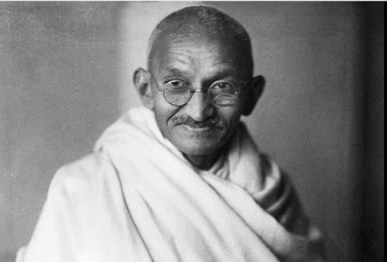
In an article published on the site Kashmir ReaderEnglish daily newspaper published in Srinagar, the main city of the Cashmire Valley, founded in 2012 with the motto “Nothing but news”, Professor Hamid Nasem Rafiabadi returns to the depth of the Gandhi report to Islam. Recognized specialist in Islamic thought and interreligious relations, former director of the Institute of Islamic Studies at the University of Cashmere, Professor Rafiabadi specifies that the admiration of Gandhi for the Koran and the Prophet Muhammad (PSL) constitutes an essential but often neglected dimension of his spiritual heritage. Gandhi saw in the humility and compassion of the Prophet a model of life that joined his own quest for truth.
According to him, the prophet Muhammad was “a magnificent prophet, without fear, turned towards God, animated by an unlimited compassion for humanity”. Gandhi said that a truth researcher could only admire such a moral and spiritual example. Professor Rafiabadi also underlines that Gandhi saw in Islam a religion of peace and justice, at the antipodes of violent or coercive interpretations. For him, a sincere reading of the Koran confirmed freedom of conscience and equality between human beings, so many values that resounded with his own spiritual and political quest.
During the score riots, Gandhi went so far as to declare that if a Muslim should be killed, his own life was to serve as a ransom. A word he put in practice by interposing, at the risk of his life, between Hindu and Muslim communities. Since Srinagar, in the heart of cashmere-a region itself crossed by political and religious conflicts for decades-the words of Professor Rafiabadi have taken a particular resonance. In this fragile space, where coexistence remains a vital issue, recalling the Gandhian heritage of fraternity and non-violence is also a call to rethink the future on bases of justice and shared dignity.
This article highlights a crucial point: Gandhi has never reduced Islam to its caricatures or its political drifts, but it saw it as a universal source of ethics and peace. In the current context of identity tensions, this reading recalls that a true dialogue between religious traditions is only possible to recognize its spiritual and moral dimension, rather than locking them in logics of power and domination.
