
Gaza: CNN reveals that the Israeli army pushed and buried Palestinian bodies with bulldozers
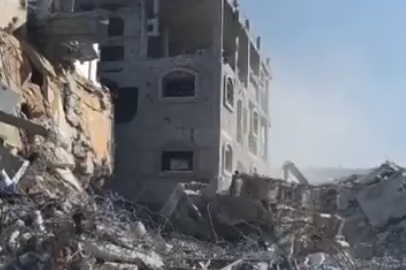
A damning report from CNN highlights a terrifying practice around the Zikim crossing, north of Gaza: the Israeli army is said to have, on several occasions, bulldozed the bodies of Palestinians who came to seek food aid, burying them in crude pits or leaving them to decompose in the open air. The investigation is based on hundreds of videos, testimonies from eyewitnesses, aid truck drivers, as well as analyzes of satellite images. They all describe the same scene: starving civilians, under regular army fire, falling near aid distribution trucks. Many have never been found.
CNN has identified at least two videos showing partially buried bodies piled near an overturned truck after a day of shooting last June. Humanitarian aid drivers report seeing Israeli bulldozers pushing bodies into the sand, sometimes mixed with aid boxes. Two former Israeli soldiers, who testified anonymously, confirm that this practice occurred elsewhere in Gaza during the war: corpses left for days in the sun, then covered in earth without identification. One of them speaks of an unbearable smell, of stray dogs devouring the bodies, and above all of the total absence of protocol for treating the remains.
For families, the nightmare continues. Many, like that of Ammar Wadi — who left to look for a bag of flour and never returned — are still looking for a body, a trace, a sign. “We accept fate,” said his mother. But we want to know what happened to our son. » The scenes described in this report join a series of revelations about how the Israeli army has treated the Palestinian dead since the start of the war. Already last year, mass graves were discovered on the grounds of several hospitals, and cemeteries were literally razed by bulldozers. For human rights organizations, these processes are part of a logic of erasure and dehumanization.
Beyond the images, it is the silent disappearance of many Palestinians that is striking. Dozens of men and teenagers who left behind only cell phones, farewell messages, or the memory of a last attempt to find food. Their families wander between the tenuous hope of finding them alive and the painful certainty that they lie somewhere under the sand moved by a machine. The report finally highlights the total opacity of the Zikim crossing area, described by several witnesses as a “lawless zone”, inaccessible to rescue teams and humanitarian organizations. This void of transparency maintains suspicions and reinforces a single certainty: without independent access, the truth about what happened there risks remaining buried, too, under the layers of earth that the bulldozers have displaced.
