
Gaza without the Palestinians: Trump’s “Peace Council”, a colonial peace without a say
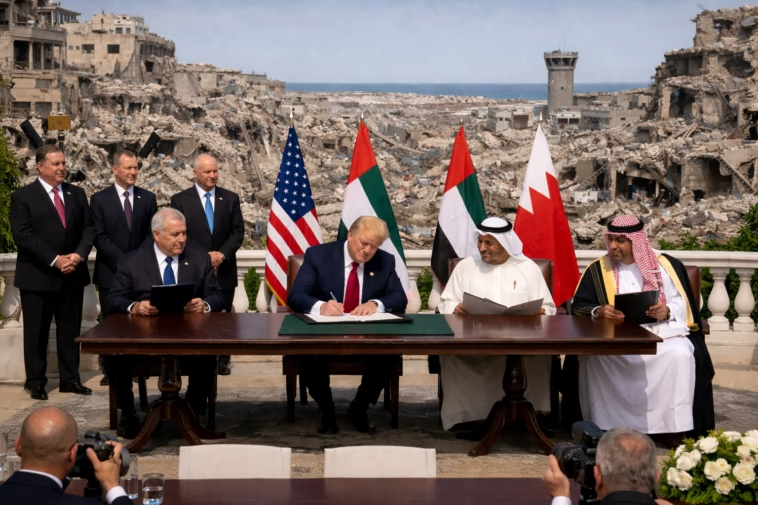
Trump’s proposed “Peace Council” imposes a colonial vision of international relations, excluding Palestinians from decisions about their future.
WHY READ:
- Analysis of the implications of the Peace Council on Gaza.
- Critique of the neocolonial vision of peace.
- Reflection on the role of powers in conflicts.
Behind the reassuring words of “stability” and “lasting peace”, the “Peace Council” project carried by Donald Trump reveals a brutal and profoundly neocolonial vision of international relations. Presented as a more “effective” alternative to existing institutions, this initiative is in reality based on a simple and chilling idea: peace is decided between the powerful, is financed at a high price and is imposed on the peoples concerned. Gaza is the most striking — and most worrying — example.
Gaza as a diplomatic pretext
Originally, the Peace Council was to oversee the reconstruction of Gaza after months of massive destruction. But the project charter, as it circulates today, quickly empties this promise of its substance. The Palestinian territory almost disappears from the text, replaced by a vague objective: to resolve armed conflicts in the world. Gaza becomes a showcase, a pretext for launching, not a political priority.
Even more serious, the Palestinians never appear as legitimate actors. No Palestinian representative, no elected authority, no grassroots organization is called upon to participate in decisions on the future of Gaza. We talk about reconstruction, governance, security — but never about sovereignty, rights, or even Palestinian speech.
An imposed peace, against the people and multilateralism
This silence is not insignificant. It is part of a long colonial tradition where external powers claim to decide for a territory without consulting those who live there. Trump’s Peace Council is fully in line with this logic. Gaza is not seen as a political space inhabited by a people, but as a problem to be managed, a territory to be pacified.
In this scheme, peace is no longer the result of an inclusive political process. It becomes a technocratic operation, led by foreign leaders, Western diplomats, financiers and billionaires. In other words, peace without justice, without memory and without responsibility.
The project barely accepts its hostility towards the United Nations. The charter criticizes institutions deemed too slow, too restrictive, too ineffective. In short: too attached to international law, too respectful of equality between States, too attentive to the demands of dominated peoples. By proposing a parallel structure, Trump is not seeking to improve multilateralism. He tries to get around it. The Peace Council replaces law with selection, deliberation with invitation, and legitimacy with money.
A billion to sit, zero to exist
The ideological heart of the project is contained in one sentence: to retain a seat beyond three years, a state will have to pay more than a billion dollars in cash. It is not a simple financing mechanism. It’s a political filter. A test of allegiance. A way of automatically excluding poor countries, marginalized states, those who suffer conflicts without ever deciding them.
In this system, Gaza has no chance. Palestinians, already deprived of a state and fundamental rights, are now deprived of any voice in a body supposed to decide their future.
Trump at the center, deciding without the people
Donald Trump places himself at the top of the system: inaugural president, master of invitations, arbiter of exclusions, supervisor of votes. This concentration of power transforms the Peace Council into a personal tool, without collective logic. It is not an international organization, but an assumed political hierarchy.
Peace then becomes an instrument of control: controlling territories, controlling alliances, controlling narratives. France’s refusal to participate underlines the problematic nature of the project, particularly with regard to respect for UN principles. Conversely, Morocco’s acceptance of the role of “founding member” raises questions. What does it mean to participate in a forum that talks about Gaza without the Palestinians?
A pacification, not a peace
One thing is clear: peace without the Palestinians is not peace. It is an imposed pacification, a facade stabilization intended to reassure the powerful and make a territory “manageable”. History has shown it everywhere: excluding a people from decisions about their own future produces neither stability nor lasting security.
Trump’s Peace Council does not correct the failures of multilateralism: it radicalizes its injustices. And in Gaza, this project does not promise peace — it institutionalizes silence.
