
Halal fast food: KFC advances, junk food remains
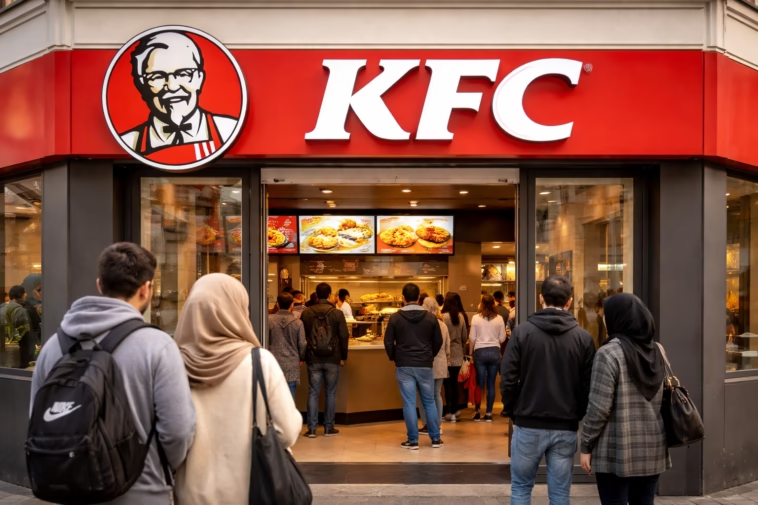
The rumor had been circulating on social networks for several days. It is now confirmed. KFC announces that 24 of its 404 restaurants in France will offer halal-certified chicken from January 21, 2026. A marginal development on a national scale, but sufficient to relaunch a recurring, often passionate, debate around food and identity.
The American brand justifies this choice by a desire to respond to “a growing demand from a portion of consumers” and to support market developments. This is therefore neither a general shift nor a radical change of direction: only certain establishments will be affected, with communication ensured restaurant by restaurant.
In detail, this experiment will first concern the Grand Est, with eleven restaurants, including three in the Troyes metropolitan area, five establishments in Strasbourg and its surroundings, that of Mulhouse, as well as two on the outskirts of Nancy. In Hauts-de-France, seven KFCs will switch to halal, notably in Denain, Roubaix, Tourcoing, Maubeuge, as well as the three restaurants in Amiens (North, city center and South). Two establishments are also concerned in Île-de-France, in Seine-Saint-Denis, in Romainville and Montreuil. In Auvergne-Rhône-Alpes, the restaurants of Échirolles, near Grenoble, and Villars, near Saint-Étienne, will be part of the system, as will those of Rouen Saint-Sever in Normandy and Perpignan Castillet in Occitanie.
A commercial decision above all
KFC is not an isolated case. In recent years, several fast food chains have chosen to integrate halal into their offering. Five Guys, more recently, or even Quick, which has largely made halal meat available since 2021, illustrate the same logic: adapting to the diversity of consumers. In an ultra-competitive sector, ignoring a significant part of the customer base is less a matter of principle than a risky bet.
However, with each announcement, the same controversy resurfaces. Halal is presented by certain political leaders and editorialists as an ideological concession, or even as a cultural threat. An excessive reading to say the least. In fact, it is only an additional option, left to the free will of consumers. No one is forced to consume halal, nor does this offer lead to the disappearance of others. This repetitive agitation speaks more of identity tensions than of the reality of a market that adapts.
Halal or not, the health question remains
Behind this noisy debate, an essential question remains largely hidden: that of health. Halal or not, fast food remains an industrial, ultra-processed food, rich in saturated fats, salt and calories. Studies carried out by reference organizations, such as the World Health Organization, have long established a link between regular consumption of fast food and an increased risk of obesity, type 2 diabetes, cardiovascular disease and even hypertension.
Frying, omnipresent on the menus of chains like KFC, poses a specific problem. Consumed repeatedly, it promotes metabolic imbalances and primarily affects those most exposed to street food, particularly young people. Ultimately, KFC’s partial transition to halal does not change the nature of the product. Respect for a religious framework is legitimate and necessary for certain consumers, but it does not transform junk food into a balanced diet.
This development also questions the role of major brands in contemporary eating habits. By multiplying adaptations – halal, vegetarian, alcohol-free – fast-food chains seek above all to capture market share, without calling into question a model based on rapid and repeated consumption. However, the real question remains that of access to healthy, affordable and quality food for all. As long as this dimension remains marginal, identity debates around menus will continue to occupy media space, to the detriment of broader reflection on our collective relationship to food and health.
