
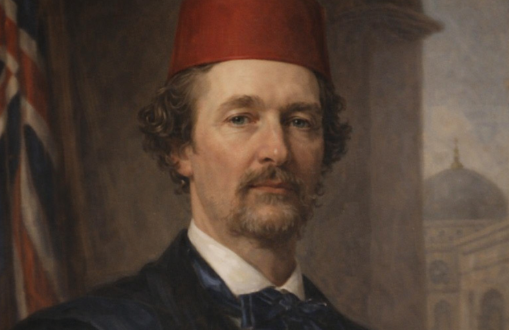
In 1859, he was a British lord…and he became a Muslim
- Discover the little-known story of a British lord who became a Muslim.
- Explore the influences of the Ottoman Empire on the Victorian aristocracy.
- Understand how Islam was perceived in Europe in the 19th century.
In the 19th century, the British Empire was at its peak. And yet, at the very heart of the Victorian aristocracy, a lord will make an unthinkable choice for his time: embrace Islam.
A British lord converted to Islam in the 19th century
In 1859, he belonged to the British nobility… then he chose Islam. pic.twitter.com/7Q9vLYvzFS
— Oumma.com (@oumma) February 18, 2026
Born in 1827, promised a brilliant career within the British elite, Lord Henry Stanley began a journey that led him to travel to Eastern Europe and the Ottoman Empire. HAS Istanbulhe discovered Islam. Not as an oriental curiosity or simple folklore, but as a structured, living faith, deeply anchored in everyday life. Behind this little-known trajectory lies a very real figure in British political history: Henry Stanley, 3rd Baron Stanley of Alderley.
A spiritual discovery in the heart of Victorian England
After graduating from Eton and then Cambridge, Henry Stanley began a career as a diplomat and parliamentarian. But it was during his travels in the Eastern Mediterranean, and particularly in Istanbul, then capital of the Ottoman Empire, that his perspective evolved. Far from the often caricatured image conveyed in imperial circles, he discovered a religious tradition which goes beyond the private sphere alone to structure social ethics and relationships with the world. This meeting acts as a revealer.
Little by little, Stanley moves away from institutional Christianity. He questions certain dogmas, criticizes the political role of the Church and adopts a more austere lifestyle, breaking in particular with certain worldly habits of his environment. It was in the 1860s that his conversion to Islam seemed to materialize, without public declaration or spectacular break. Henry Stanley seeks neither to provoke nor to convince. He does not make his faith a media battle. But he doesn’t deny it either.
When he entered the House of Lords in 1869, after inheriting his title of baron, he sat there as a Muslim – which made him, according to several historians, the first Muslim member of the upper house of the British Parliament.
A fact largely overlooked in the dominant narratives of UK political history. This trajectory is not completely isolated in Victorian England. In the 19th century, diplomatic, commercial and intellectual exchanges with the Ottoman Empire aroused a real curiosity about Islam among certain members of the British elite. Without systematically leading to conversions, these contacts nevertheless contribute to shifting dominant representations and bringing out unexpected forms of spiritual and philosophical interest. Henry Stanley’s journey is thus part of a historical moment where Islam, far from being perceived solely as an object of otherness, also becomes, for certain Europeans, a source of religious and moral reflection.
A faith lived at the heart of the establishment
Settled on his land in Cheshire, Stanley puts some of his moral convictions into practice. It supports local social initiatives and finances religious constructions, whose architecture sometimes incorporates Islamic-inspired motifs. Without ostentation, he embodies a form of intimate spiritual adherence, compatible with his public role but in silent rupture with the norms of his time.
At a time when Islam is often presented as a reality exogenous to European history, Henry Stanley’s journey recalls an obvious fact that is too often obscured: The Muslim presence in Europe does not begin with contemporary migrations. It also crosses the elites, the individual conversions, the intellectual exchanges and the personal itineraries which have profoundly shaped the history of the continent.
