
Iran: a power that discreetly shifts from clerics to the Revolutionary Guards
- Understand the current power dynamics in Iran.
- Analyze the impact of the Revolutionary Guards on Iranian politics.
- Explore the economic implications of this power shift.
For a long time, Iran was described as a country run almost exclusively by clerics. This image, often summarized by the expression “country of the mullahs”, remains very present in Western media discourse. However, it no longer really corresponds to the reality of power in Tehran. For several years, a profound but discreet shift has been at work: the center of gravity of the Iranian regime has shifted from religion to a military-security structure dominated by the Revolutionary Guards.
An increasingly weakened supreme leader
On the institutional level, supreme power in Iran remains officially concentrated in the hands of the Supreme Leader, today embodied by Ali Khamenei. But in reality, its authority has clearly eroded. His advanced age, his state of health and above all the regime’s inability to improve the economic and social situation of the country have weakened his role as central arbiter.
Once indisputable, his word is now discussed, sometimes circumvented, by other centers of power. On major issues such as nuclear power or relations with the United States, his hard line is perceived by some of the elites as a strategic brake rather than as an ideological guarantee.
A force born in 1979 that became a parallel army and a pillar of the regime
The Islamic Revolutionary Guard Corps was established in 1979, in the immediate aftermath of the Islamic Revolution. Their initial mission was clear: to protect the new regime against any threat, whether external or internal. At the time, revolutionary leaders were wary of the regular army, considered too linked to the former Shah regime. The Guardians were therefore designed as a parallel force, ideologically loyal to the new power and directly attached to revolutionary authorities. This military duality still exists today in Iran.
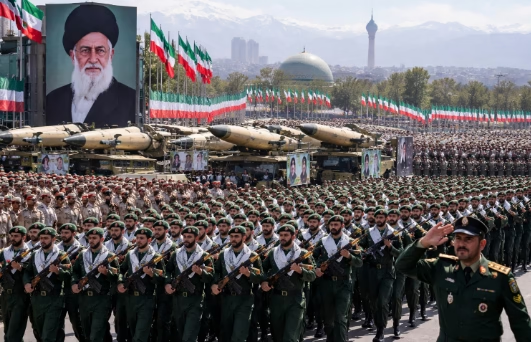
Today, the Revolutionary Guards have between 125,000 and 150,000 members. Added to this force is the Bassidj militia, a paramilitary organization capable of mobilizing several hundred thousand volunteers, particularly for maintaining order and repressing internal protests.
The Guardians have their own land, naval and aerospace forces. In particular, they control the ballistic missile program, the development of military drones, as well as part of the naval capabilities in the Gulf. This military autonomy gives them considerable strategic weight, often greater than that of the regular army. Beyond Iran’s borders, the Revolutionary Guards play a central role in the country’s power projection. They are at the heart of Iranian regional strategy, based on indirect alliances and networks of influence in the Middle East.
This capacity for external action, often discreet, allows Iran to influence regional balances without direct military confrontation. It also strengthens the legitimacy of the Guardians as protectors of the country’s strategic interests.
Political influence reinforced by an economic empire
Over time, the Revolutionary Guards have far exceeded their military role. Many former commanders now occupy key positions in political institutions: Parliament, government, local administrations and security agencies. This presence allows them to directly influence political decisions and to influence major national guidelines. Their power rests less on the ballot box than on their ability to control the essential levers of the State. One of the most defining aspects of their power is their economic influence. The Guardians control or influence entire sectors of the Iranian economy: energy, oil, major works, telecommunications, port infrastructure, foreign trade.
They have powerful conglomerates, often protected from international sanctions thanks to complex networks. This economic domination ensures them considerable financial resources and rare autonomy within the Iranian system.
A regime in transition, far from the simple “country of the mullahs”
Contrary to the image of a frozen system, Iran is already engaged in an internal transition. A possible departure of the Supreme Leader would not necessarily cause a major shock. Power now operates on a balance where key decisions are largely influenced, even led, by the Revolutionary Guards.
It would therefore not be a question of a sudden change of regime, but of a gradual, almost silent evolution. The religious setting remains, but the real power has moved elsewhere.
Reducing Iran to a regime solely dominated by the clergy prevents us from understanding its current dynamics. Religion retains an important symbolic and ideological role, but it is no longer the main engine of power. Today, Iran more closely resembles a state where a military-security structure dominates strategic decisions, while religion serves as a legitimizing framework. Understand the central role of Islamic Revolutionary Guards is therefore essential to understand the present and future developments in the country.
The real question may no longer be who officially governs Iran, but who actually holds power — and according to what priorities.
