
“Islam, an integral part of European history” – the prestigious English magazine New Statesman recalls a forgotten truth
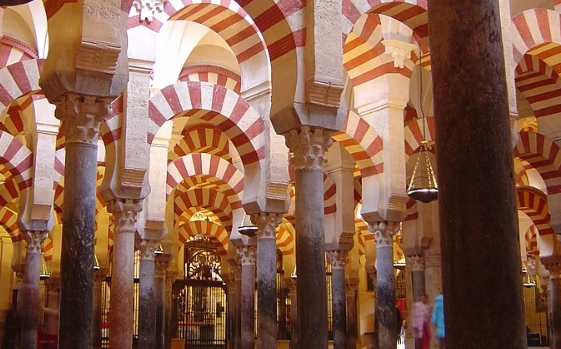
In a long article published by the prestigious magazine New Statesmanhistorian David Motadel returns to a stubborn blind spot: the central place occupied by Islam in European history. A reality that was already recalled, in 1993, by the current King Charles III in a visionary speech in Oxford, deploring the systematic erasure of this heritage in dominant historical narratives.
Motadel relies on the work Muslim Europe by Tharik Hussain, a journey through Cyprus, Sicily, Malta, Portugal and Spain in search of the traces left by 1,400 years of Muslim presence. From the arrival of Islam on the island of Cyprus, only sixteen years after the death of the Prophet, to the apogee of al-Andalus, Hussain shows how European history was shaped by these centuries of contact, exchange and creativity.
The author emphasizes the contemporary effects of this amnesia. By denying this past, Europe fuels both the exclusionary discourse of the far right and the feeling of uprooting among some of the continent’s Muslims. However, Motadel recalls, Muslim contributions – in agriculture, in science, in the arts, in urban planning – were decisive, even if Hussain sometimes tends to idealize this golden age.
The work remains a travel story more than an exhaustive historical study, believes Motadel, regretting that the author neglects the Ottoman history of the Balkans or the more recent legacies linked to the colonial empires. But Muslim Europe has the merit of shattering a false but persistent idea: Europe has never been an exclusively Judeo-Christian bloc. Muslims have occupied a major, ancient and lasting place there.
Beyond the historical debate, the magazine article asks an essential question: why was the construction of European identity achieved by erasing its Muslim dimension? David Motadel suggests that this obscuration has nourished a reductive vision of Europe as a homogeneous cultural fortress, making current societies more vulnerable to discourses of withdrawal. Recognizing this past plurality could, on the contrary, offer a more inclusive common horizon, faithful to the reality of history.
Finally, David Motadel emphasizes that this work of memory is not only intended for non-Muslim Europeans. It can also contribute to healing internal fractures in European societies by offering young Muslim generations a more solid historical inscription, far from identity assignments and stories of rupture. Restoring the complexity of history, he implicitly writes, is not an academic luxury: it is a condition for preventing the tensions of the present from transforming, tomorrow, into irreversible fault lines.
