
Israel bombers Iran: preventive war as a doctrine, impunity as a strategy
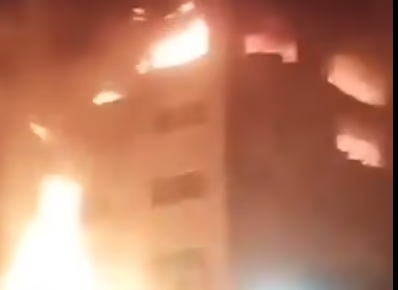
While Gaza is still in ruins, Israel opens a new front. Two hundred fighter planes led a massive offensive against Tehran and several Iranian cities, in what Tel Aviv presents as a “preemptive” operation. Iran promises to retaliate. The region is on the edge of the abyss.
A night of fire on Iran: 200 planes on destruction mission
Shortly after midnight, explosions of rare intensity rocked Tehran. In a few hours, 200 Israeli combat aircraft struck a hundred military and strategic targets across Iran. The strikes targeted the Shian military base, the Revolutionary Guard’s Command Center, as well as several residential buildings in the capital. Other key sites have been targeted: the base of parchin to the east, the arsenal of bid Kaneh missiles to the west, and major nuclear installations in Natanz, Isfahan, Arak and Tabriz.
The objective is clear: beyond infrastructure, it is the brains and symbols of Iranian military power that the operation sought to destroy. Six scientists of the nuclear program were killed. But the heaviest human losses for the Iranian regime are political.
Israel Carried out a “Major Strike” on Iran Early Friday Morning, Hitting A Range of Targets in the Capital, Tehran. pic.twitter.com/2n98rbmbtv
– Al Jazeera English (@Ajenglish) June 13, 2025
Two key figures from Iranian military power eliminated
Among the dead is General Mohammad Bagheri, chief of staff of the armed forces since 2016. Craftsman of the Iranian ballistic program and close to the supreme guide Ali Khamenei, he played a strategic role in the military projection of Iran in Syria, Iraq and Lebanon. Target for a long time for Israel, Bagheri had been punished in 2022 for his role in the delivery of drones to Russia in the midst of war in Ukraine.
Another major loss: General Hossein Salami, commander -in -chief of the revolution guards. Former veteran of the Iran-Iraq war, he was considered one of the most influential pillars of the security apparatus of the Islamic Republic. His disappearance could upset the internal balance of power in Tehran.
“It is not a war,” said the Israeli ambassador to France, however. But who sends 200 planes without triggering a war? This operation is part of the doctrine of the “preemptive war”, a blurred concept brandished to justify preventive strikes in the absence of proven aggression. Introduced by the United States during the invasion of Iraq in 2003, this framework makes it possible to act unilaterally without the United Nations mandate. However, international law is clear: only an ongoing aggression can justify the self -defense.
While the Security Council remains paralyzed by the American veto, the general assembly of the United Nations, for its part, adopted an overwhelming majority of resolution requiring an immediate, permanent and unconditional ceasefire in Gaza: 149 votes for, 12 against, 19 abstentions. A strong political signal, even if it remains symbolic. The contrast between this peaceful resolution and the bombs that rain on Iran speaks volumes about the current diplomatic priorities.
A message to the entire Middle East
Beyond the nuclear program, this operation marks an assumed will to impose Israeli domination by force throughout the region. Washington, informed in advance, deployed an F-15 squadron in Jordan to intercept a possible Iranian response, including a hundred drones that are in flight to Israel. Amman has closed his airspace, refusing that his territory be used in this conflict.
Tehran, for his part, promises an answer. The Iranian government claims that these strikes only strengthen its determination to enrich uranium and develop its defense capacities. “We are not talking to a predatory regime other than for force,” he says.
Israel, already accused of war crimes in Gaza, pushes its logic of raw power even further. Two hundred fighter planes, an offensive on the scale of a war, of strategic figures eliminated, and the embarrassed silence of a part of the international community. At a time when Gaza civilians are dying of hunger and when the UN institutions are calling for a ceasefire, Tel Aviv chooses climbing. Military impunity becomes a political strategy. And for the moment, no one seems ready to stop it.
