
Jamil Al-Amin, major figure of Black Power from revolt to faith, dies at 82
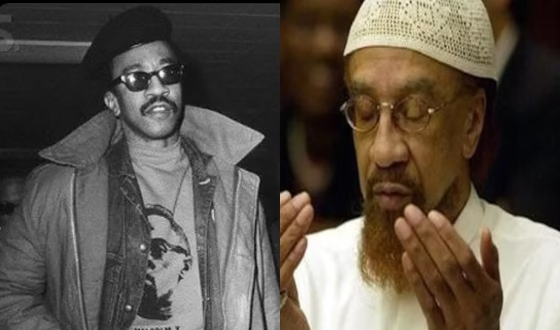
Major figure of Black Power under the name of H. Rap Brown, Imam Jamil Abdullah Al-Amin died Sunday at the age of 82 in a federal center in North Carolina. Very early on, this son of Baton Rouge refused to let himself be defined by the state. A voice for black anger in the 1960s, he denounced an America incapable of confronting its history and uttered phrases that have become emblematic: “Violence is part of American culture. As American as cherry pie. »
At the age of 23, he took the helm of the Student Nonviolent Coordinating Committee and shook up the codes, even pushing to remove the word “nonviolent” from the name of the movement. His fiery speeches irritate Washington. The FBI placed him among its priority targets and Congress adopted a law in 1968 nicknamed “H. Rap Brown Law”.
Convicted after a shooting in 1971, he spent five years in Attica. In prison, he converted to Islam and began a profound transformation. Becoming Jamil Al-Amin, he settled in Atlanta, founded a mosque, opened a business, launched programs for young people and tried to rid his neighborhood of drugs. For many, he became a respected guide. For the authorities, he remains a monitored activist.
In 2000, he was convicted of the death of a sheriff’s deputy, a charge he denied. Yet another man confessed to the crime several times. Despite this, justice has never returned to the case. His relatives have been denouncing for years a miscarriage of justice and undignified conditions of detention, while his health was deteriorating.
His death today revives calls for the case to be reopened. THE Council on American-Islamic Relations (CAIR), the leading Muslim civil rights organization in the United States, speaks of a “hero of the civil rights movement” who was the victim of injustice. Those around him remember a man who moved from political confrontation to spiritual quest, without ever renouncing the idea that freedom requires organization, courage and principles. Jamil Al-Amin leaves behind a history of segregation, state repression, faith and community involvement — and a legacy that his supporters promise to keep alive.
