
Kidnapping of Maduro: in the Muslim world, condemnations, caution and silence after the American attack on Venezuela
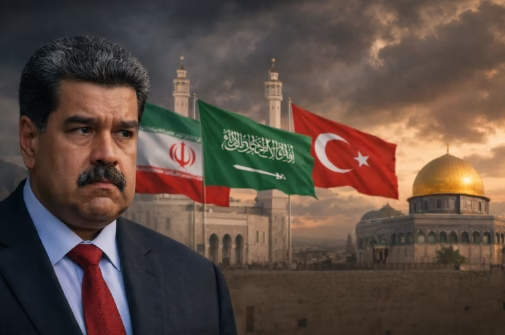
The US attack on Venezuela and the kidnapping of Maduro are provoking varied reactions in the Muslim world.
WHY READ:
- Analysis of international reactions to American aggression.
- Examination of the positions of Muslim countries and the OIC.
- Reflection on the impact of this situation on international law.
US-led military attack on Venezuela followed by kidnapping of president Nicolas Maduro and his wife, caused an international shock wave. Presented by Washington as a “strategic security” operation, the intervention raises serious legal and political questions. It is above all part of a logic of violent imperialism, where the control of energy resources – in particular Venezuelan oil – takes precedence over respect for international law and the sovereignty of peoples. A constant in American foreign policy, which transforms military force into an instrument of economic predation and geopolitical domination.
In terms of international law, the unilateral use of force outside of any UN mandate, combined with the kidnapping of a sitting head of state, constitutes a direct challenge to the principles supposed to govern the world order. A new illustration of an international system with variable geometry, where legality fades when American strategic interests are at stake. In the Muslim world, reactions reflect a deep fragmentation, revealing balance of power, regional alliances and assumed diplomatic calculations.
Firm condemnations and solidarity displayed
Among the first reactions, Iran denounced a clear “military aggression” and a clear violation of the United Nations Charter. Tehran called on the international community to unambiguously condemn the use of force against a sovereign state, saying that the kidnapping of a head of state constitutes a dangerous precedent for the already fragile balance of international relations.
In Sanaa, the de facto authorities linked to the movement AnsarAllah also condemned the American operation, accusing Washington of trampling on international law and affirming their solidarity with the Venezuelan people in the face of what they describe as an act of brutal hegemony. In Southeast Asia, Malaysia stood out for the clarity of its position. The Prime Minister Anwar Ibrahim demanded the immediate release of Nicolás Maduro, recalling that the kidnapping of a president by a foreign power dangerously weakens the mechanisms supposed to prevent arbitrariness and the law of the strongest.
In Africa, several Muslim-majority countries have expressed support for Caracas. Mali, Burkina Faso and Niger denounced illegal strikes targeting civilian and military targets, citing a serious attack on Venezuelan sovereignty. Nigeria also recalled the importance of respecting international standards and the territorial integrity of States. However, at this stage, no common position has emerged. Within theOrganization of Islamic Cooperationno strong collective declaration has made it possible to draw a unified line, illustrating the persistent incapacity of the institutional Muslim world to respond in a concerted manner to violations of international law when they emanate from Western powers.
Arab silences and diplomatic caution
Conversely, several states have opted for a measured posture. Qatar expressed its “deep concern,” calling for de-escalation and offering mediation. Indonesia and Türkiye limited themselves to general reminders to respect international law, without explicitly designating American responsibilities. But it is above all the silence of the Arab world and the Maghreb which calls out. Neither Saudi Arabia, the United Arab Emirates nor Egypt have reacted officially. In North Africa, Morocco, Algeria and Tunisia have remained silent, despite a discourse traditionally attached to state sovereignty.
This silence is not trivial. It reflects a tacit acceptance of an international order dominated by Washington, now led by Donald Trumpwhere the kidnapping of a sitting president can be relegated to the rank of collateral damage as long as it fits into American strategic priorities. A reality which further weakens the credibility of an international law invoked selectively, and rarely applied to the powerful.
