
Louis Blin: “By denying Napoleon’s Islam, France is denying a part of itself”
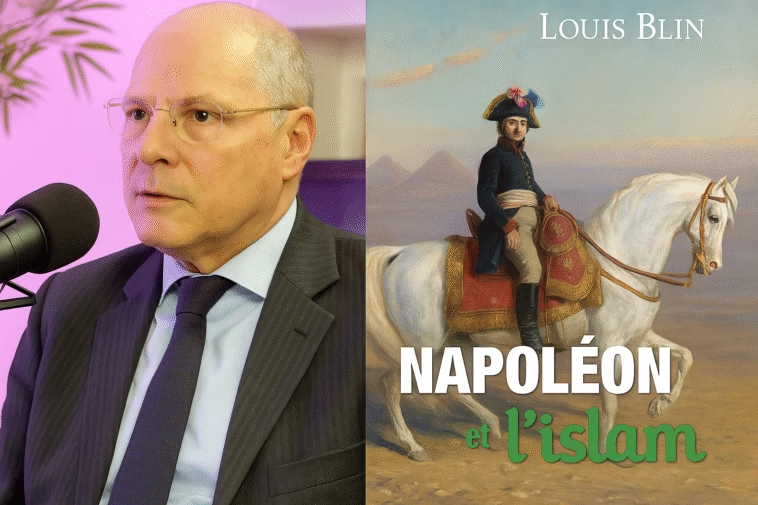
In a fascinating interview, the diplomat, historian and Arabist Louis Blin presents his work Napoleon and Islampublished by Érik Bonnier. He defends an idea that is disturbing to traditional historiography: Napoleon Bonaparte, far from being solely a Western conqueror, was also a man deeply fascinated by Muslim civilization – to the point, perhaps, of adhering to it spiritually. This book, of high quality analysis and writing, revisits with rigor and clarity this complex relationship between the Emperor and Islam. We highly recommend reading Napoleon and Islam.
Report of the interview with Louis Blin, author of the book Napoleon and Islam published by Éric Bonnier
A Tuscan and Mediterranean heritage
Louis Blin first recalls that Napoleon was not originally French. “Napoleon is often made a Corsican, a Corsican Frenchman. He was neither French nor Corsican, he was Italian from Tuscany,” he explains. This cultural belonging to a region open to the Mediterranean would have favored his curiosity towards the Orient and Islam. In Tuscan ports, commercial and intellectual exchanges with the Muslim world were constant. “He had not inherited French prejudices towards the other side,” underlines Blin.
The influence of Rousseau and Savary’s Koran
Two major sources fuel this attraction: Jean-Jacques Rousseau, whose philosophy Napoleon admired, and Savary’s translation of the Koran. Rousseau saw in Islam a model of social order and civil peace, capable of overcoming religious divides. As for Savary, his translation of the Koran, preceded by a biography of the Prophet, had a lasting influence on Napoleon, who read it all his life. For Blin, Bonaparte sought in Islam a response to the divisions that were gnawing away at revolutionary France.
Affirmed Islam in Egypt
In Egypt, Napoleon reached a milestone: he publicly proclaimed his belonging to Islam, pronounced the shahada and adopts the first name Ali. For Louis Blin, “there is no doubt: when we affirm ourselves to be Muslim without constraint, it is because we are”. However, this Islam does not mean a break with Catholicism. Napoleon, a megalomaniac and universalist, thought he could reconcile monotheistic religions. “He was a sociological Catholic but a Muslim at heart”says Blin.
What if Napoleon had been Muslim? Historian Louis Blin shakes up French history
The diplomat, historian and Arabist Louis Blin, author of the book “Napoleon and Islam” (ed. Erik Bonnier), affirms that Bonaparte pronounced several shahadas and that “he did not… pic.twitter.com/D89yzNW6T2
— Oumma.com (@oumma) November 8, 2025
Islam, a social model more than a faith
Napoleon would not have been interested in Islam as a mystical spirituality, but as a model of social organization. An admirer of the Prophet Muhammad, whom he placed above Alexander the Great, he saw in Muslim civilization a political and moral structure superior to that of the Catholicism of his childhood. For Louis Blin, this preference reveals the vision of a man in search of unity, seeking to integrate the social values of Islam into his conception of the State.
Between ideals and violence
Questioned about the massacres committed in Egypt and Palestine, Louis Blin recognizes the contradiction: how could a man fascinated by Islam be able to massacre Muslims? “It’s the gap between convictions and the thirst for power”he explains. Napoleon believed he was bringing civilization, but faced with resistance from the Egyptians, he imposed by force what he was no longer able to convince. For Blin, this violence stems from colonial logic and not religious hostility.
Islam obscured by colonization
Throughout the 19th century, Napoleonic Islamophilia posed no problem: General Menou, converted to Islam, even commanded the army of Egypt and his name appears on the Arc de Triomphe. It was only with the colonial era that Napoleon’s Islam became taboo. “Refusing this part of him is a form of national self-hatred”says Louis Blin. French historiography would have voluntarily erased this dimension to align Napoleon with a nationalist and Christian vision.
Napoleon, a model of integration
In conclusion, Louis Blin believes that rediscovering Napoleon’s Islam could help to calm France’s relationship with Islam and Muslims. Bonaparte, a Tuscan immigrant who became Emperor of the French, Catholic by culture but Muslim by conviction, embodies, according to him, the possibility of a reconciled identity. “It can serve as a model if we finally accept that Islam is not incompatible with Frenchness.”
Through this erudite and deeply topical book, Louis Blin invites us to reread Napoleon not as a fixed national hero, but as a symbol of openness, dialogue and integration.
