
Malaysia: halal has become a tool of global influence
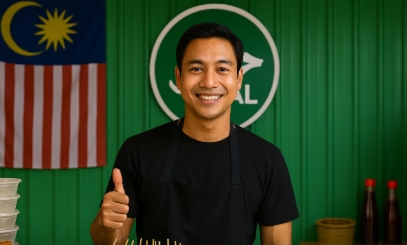
Malaysia has succeeded where few Muslim countries have truly succeeded: making halal no longer just a religious framework, but a lever of international influence. Thanks to JAKIM and the Halal Industry Development Corporation, the country has transformed halal certification into a mark of trust, at the intersection of economy, diplomacy and soft power.
From Mahathir and Vision 2020 to Anwar Ibrahim today, Kuala Lumpur has built a coherent strategy: presenting a model of Muslim modernity anchored in rigor, ethics and administrative efficiency. Halal has thus become a “Malaysia label”, visible in food, finance, tourism, cosmetics and even logistics. The value of global halal – already estimated at nearly $2 trillion in 2021 – is expected to almost double by 2027, an area where Malaysia intends to stay ahead.
Facing it, Indonesia is trying to impose itself. It has centralized its certification system and has incomparable demographic weight. But despite its ambition, institutional fragmentation and low international visibility prevent it, for the moment, from competing with the Malaysian machine. For example, Malaysia’s halal exports reached 55 billion ringgit (approximately 13.2 billion USD) in 2023, while Indonesia is still struggling to stabilize its mandatory certification system.
To maintain its lead in a halal market that has become very competitive, Malaysia is now banking on repositioning: halal aligned with ESG criteria, more ethical and sustainable, supported by regional cooperation which could, tomorrow, result in a common halal standard for ASEAN. Kuala Lumpur is also targeting 80 billion ringgit (nearly 19.2 billion USD) in exports by 2030, proof that the sector remains a political and economic pillar.
This ambition does not erase the gray areas of the system. In Malaysia, halal certification remains a sensitive area, sometimes exploited in public debates. Controversies like that of the “ham” sandwich sold in a university supermarket have shown the flaws: unauthorized logos, insufficient controls, suspicions of bureaucratic rigidity. So many signals which remind us that the credibility of the label rests as much on institutional rigor as on the trust of the general public.
At the same time, the proliferation of standards across the world – from the Gulf to South-East Asia via Thailand and Japan – is fragmenting an already complex market. Non-Muslim countries like Brazil and Australia are now among the world’s leading exporters of halal meat, a sign that the market has globalized beyond its religious base. To remain the reference, Malaysia will have to modernize its tools, notably thanks to digital traceability, and strengthen alliances. It is by embodying an open and unifying actor that Kuala Lumpur will be able to preserve its status as the world capital of halal
