
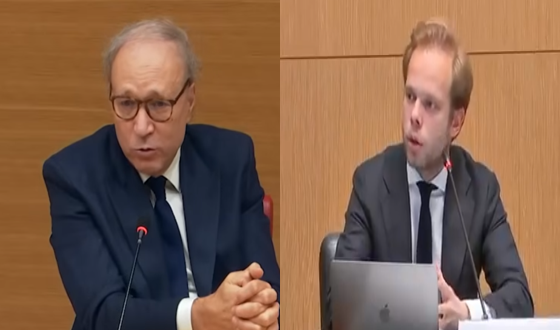
MP Charles Alloncle sees the Muslim Brotherhood everywhere and conflates Ghaleb Bencheikh with these movements
The Ciottist rapporteur Charles Alloncle, member of the Commission of Inquiry into the Neutrality, Operation and Financing of Public Broadcasting, distinguished himself during the hearing of Vincent Meslet, editorial director of Radio France, with an outing as serious as it was approximate by questioning the broadcast Islam issues broadcast on France Culture — and more particularly its host, Ghaleb Bencheikh.
During this hearing, Alloncle notably targeted certain contents of the program, including episodes devoted to religious practice in business or even to the discrimination experienced by Muslims in France. He went so far as to assert that Ghaleb Bencheikh would have participated in conferences associated with the Muslim Brotherhood “as a friend”, suggesting an ideological proximity.
Accusations that are not only unfounded, but reveal a framework where the Muslim Brotherhood seems to appear everywhere when Islam is discussed in the public space. By amalgamating everything, the MP ends up saying anything, betraying above all a manifest ignorance of Islam, its currents, its internal debates – and the intellectual positioning of those who, like Bencheikh, are part of a reformist approach breaking with political-religious readings, in favor of an enlightened Islam adapted to the modern era.
Today, the level of suspicion towards Muslims confirms a worrying shift: you only need to be Muslim to become suspect. Talking about discrimination, discussing one’s faith or participating in a public debate now exposes one to being perceived as a potential Islamist. In this climate, any Muslim can be transformed into a perceived threat. Asked about the risks linked to the visibility granted to such figures in religious broadcasts, Vincent Meslet for his part recognized that Radio France only exercised “limited control” over these programs, to the extent that they are not produced internally. A response which, far from shedding light on the debate, above all highlighted the fragility of the accusations leveled.
MP Charles Alloncle sees the Muslim Brotherhood everywhere and conflates Ghaleb Bencheikh with these movements
The Ciottist rapporteur Charles Alloncle, member of the Commission of Inquiry into the neutrality, operation and financing of public broadcasting, distinguished himself… pic.twitter.com/XsWitM0csH
— Oumma.com (@oumma) February 24, 2026
