
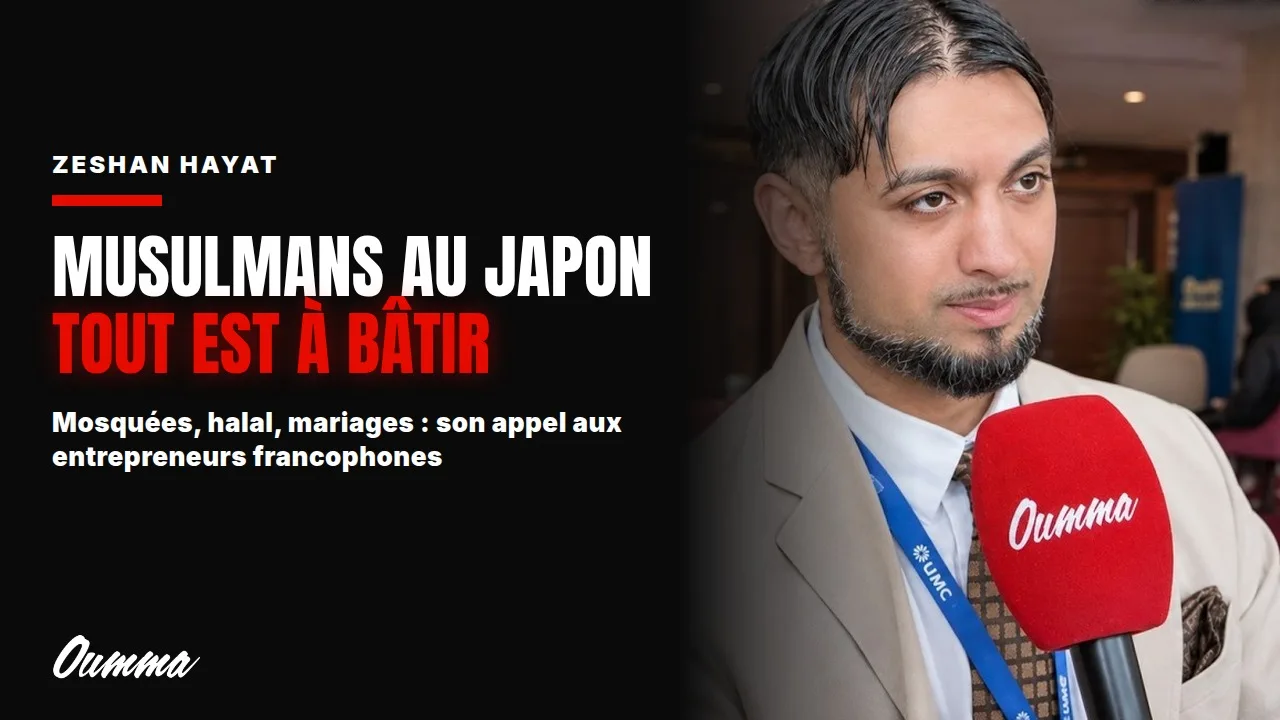
Muslims in Japan: “everything needs to be built”
Interviewed by Oumma during the fifth World Islamic Tourism Conference, organized on November 5 and 6, 2026 in Kuantan, Malaysia, Zeshan Hayat describes a growing, but still destitute, Japanese Muslim community. British of Pakistani origin, based in Japan, he founded a halal certification association and an educational program for Muslim children. His diagnosis can be summed up in one sentence: in Japan, almost everything remains to be built. And he makes it an invitation to French-speaking entrepreneurs. His remarks were made in English and are translated here.
From the United Kingdom to Japan, a journey backwards
Zeshan Hayat was born in the United Kingdom, into a family of Pakistani origin. He left to study in Japan and taught there for several years. Then, he says, his career “suddenly changed direction” after the birth of his children: he wanted to be useful to the community and has since devoted himself to building the infrastructure that the country’s Muslims lack. Two areas seem equally important to him: food and travel on the one hand, education on the other.
He describes himself as a third generation Muslim in England, but first generation in Japan. This dual perspective is at the heart of his commitment. “I see what worked well in the UK, and I see where Japan could go wrong,” he explains. Its objective: to avoid in Japan the mistakes made elsewhere, so that the faith of the younger generations remains intact. “You can have hundreds of mosques and hundreds of workplaces, but if the message does not reach hearts and children lose their faith, then setting up in Japan is a failure. »
A community from all over the world
The Muslim community in Japan is made up of very varied profiles: students, university professors, engineers who have come for a contract, residents who have settled there for good. The origins range from Uzbekistan to Libya, via Malaysia, Indonesia, Sudan, Egypt and Jordan. According to Zeshan Hayat, the Turkish and Indonesian communities are the largest. Added to this are the Japanese who converted to Islam.
He estimates the number of Muslims in the country to be around 300,000, and the number of mosques to be around 250. The work of Hirofumi Tanada, professor emeritus at Waseda University and specialist in Islam in Japan, gives similar orders of magnitude, which confirms the rapid growth. It had around 230,000 Muslims in 2020, twice as many as ten years earlier, including nearly 47,000 of Japanese nationality. According to a study he carried out with other researchers, cited by the Japanese press, there would be around 420,000 at the end of 2024, or around 0.3% of the population. The number of places of worship follows the same curve: 15 mosques in 1999, 113 in 2021, around 160 in July 2025.
For Zeshan Hayat, the scarcity of mosques and resources has an unexpected consequence: “We have to come together on many issues. » But it makes daily life difficult. “We need more support from outside Japan, more investment, more eyes on the country, to help the new generation of Muslims growing up here and the Japanese who are coming to Islam. »
“Japan today is France in the 80s”
To help a European audience understand the situation, he offers a comparison. The Muslim landscape of Japan resembles, according to him, that of France and the United Kingdom in the 1980s and 1990s: small mosques, very few halal products, language difficulties, and a majority of first generation Muslims, with “the problems of the first generation”.
The lack of burial places is a concrete example. Oumma told it in 2025: Muslims in Japan are struggling to find where to bury their dead, in a country where cremation is the norm. And the establishment of places of worship sometimes arouses local resistance, like this mosque inaugurated by the Pakistani ambassador, threatened with demolition last June.
Certify restaurants, and stand by them
Zeshan Hayat presents its activities under the name Hayat Group, which brings together several projects. The first is a halal certification association, the Halal Hayat Association Japan (HHAJ), founded in 2020. He is also, according to his biography published online, lead halal auditor for Halal Navi, a guide for Muslim travelers to Japan.
His method goes well beyond the simple label. The association begins by training restaurateurs: it explains to them Islam, what halal is and what this market represents. She then helps them adapt their recipes, find compliant ingredients, build their menu and write their procedures, up to certification. “We do not certify to then leave,” he insists. The team returns four times a year to the kitchens, alongside the chefs, to ensure “that they really understand their customer”.
The work is not limited to restaurants. Hotels and food factories are also supported, with one objective: to increase the supply of halal food throughout the country. To fill the tables, the association works with influencers and travel agencies to attract Muslim customers. An approach which joins a broader movement, already visible with the multiplication of halal menus and the opening of the first halal hotel in Japan, facing Mount Fuji.
A foundation for children’s education
The second component, the Hayat Foundation, concerns education. She produces educational materials for Muslim children in Japan, and is particularly interested in children who are neuroatypical, autistic or affected by attention deficit disorder (ADHD). She also supports their parents, to address mental health “through a positive reading of Islam”. Zeshan Hayat sums it up in his own way: “Our religion is there to produce winners. We need to remind people of this, and the Muslim community too. »
The Japanese between concern and gratitude
How do the Japanese view this growing presence? The reactions are divided, he admits. Some are happy about it. Others feel sadness: they fear that their people and the face of Japan are changing. Zeshan Hayat goes so far as to assert that a third of the country “could” be Muslim in 2050. No known demographic projection points in this direction: with 0.3% of the population at the end of 2024, even a doubling every ten years would leave Muslims below 2% by mid-century.
Its basic reasoning lies elsewhere, and it is economical. “We cannot close ourselves off like an island,” he said. Japan, whose population is aging and shrinking, needs support from outside. It is fortunate to be surrounded by predominantly Muslim countries, Malaysia and Indonesia in the lead, whose inhabitants love Japanese culture and come to discover it. These visitors support businesses, and the Japanese who understand this are grateful to them. He gives the example of a 50 or 60-year-old restaurateur who has been running his establishment for decades and suddenly has to welcome foreign customers: “It’s like going abroad without going abroad. »
“A gold mine” for French-speaking entrepreneurs
To Oumma’s question about what he expects from French-speaking entrepreneurs, the answer is clear: for Muslims, Japan is “a gold mine of business opportunities.” It proposes to review the needs of a Muslim, from birth to death. The diet is starting to be taken care of, but still requires work. Education too. And entire areas remain empty: there are no caterers or halal wedding halls, and halal bakeries are nowhere to be found.
French cuisine, very popular in Japan, seems to him an obvious avenue. It recalls the old ties between the two countries, and the French enthusiasm for manga, anime and cosplay. Many Muslims in France dream of discovering Japan. His message is clear: “Come, stay for the long term and build your business here.” We are ready to help and support you. » He adds: “We need more diversity in our diet, and more diversity in our ways of thinking. »
Basically, Zeshan Hayat doesn’t just sell a market. It describes a young community, which can still choose how it will grow, and which is looking for builders. At the same conference, Oumma also met Raad Ajlouni, who wants to revive the heroes of Muslim history using artificial intelligence.
