
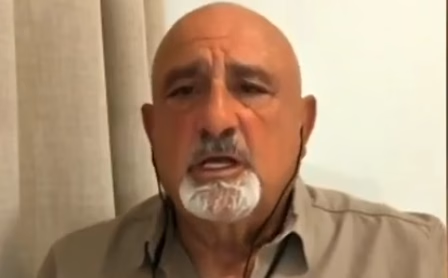
On LCI, the propaganda of a former Israeli officer sharply cropped on set
- To understand the rhetoric of war and its implications.
- To see how journalists can reframe biased narratives.
- To reflect on dehumanization in conflicts.
On LCI, a recent exchange highlighted, quite strikingly, the contrast between an assumed propaganda speech and a lucid journalistic response. On the one hand, Raphaël Jerusalmy, a former member of Israeli military intelligence, puts forward a now well-known argument: that of a war presented as necessary, almost virtuous, where “collateral damage” would be regrettable but acceptable in the name of a higher objective. On the other hand, journalist Gallagher Fenwick responds, calmly but firmly, putting him in his place.
Rhetoric that trivializes the death of civilians
Jerusalmy’s point is based on a simple, but deeply shameful idea: civilian victims would in some way be compensated by “spared” lives. A way of putting the seriousness of the bombings and their consequences into perspective, without ever providing concrete proof. Added to this is a very binary vision of the world. On one side “the forces of good”, on the other “the forces of evil”. Iran, Hezbollah, Hamas: everything is put in the same bag, without distinction, without nuance. This way of thinking erases all complexity and above all all humanity. This type of speech is not neutral. It serves to justify long wars and conflicts of attrition, by promoting the idea that civilian losses are inevitable, even acceptable. It’s a way of preparing people’s minds for escalation, by playing down its consequences.
On LCI, the propaganda of a former Israeli officer sharply cropped on set
On the one hand, Raphaël Jerusalmy, a former member of Israeli military intelligence, puts forward a now well-known argument: that of a war presented as necessary, almost virtuous,… pic.twitter.com/kJCviWsDSI
— Oumma.com (@oumma) April 10, 2026
The journalist’s clear response
Faced with this, Gallagher Fenwick does not let it go. His answer is direct, and it hits the mark. When he explains that “it is with this kind of remarks that you end up at the International Criminal Court”, he recalls a simple reality: there are rules, even in times of war. And justifying civilian losses in advance can have legal consequences.
But above all, it gets to the heart of the problem. By inviting Jerusalmy to “think against himself”, he points out this dangerous logic which consists of systematically seeing oneself as the side of good in the face of an enemy reduced to absolute evil. And he adds one essential thing: the populations opposite also want peace and security. This evidence, often forgotten in war discourse, breaks the logic of dehumanization.
This moment on LCI shows how important it is for journalists not just to relay speeches, but to question them. Faced with words that trivialize war and its effects, Gallagher Fenwick’s response is good. It reminds us that peace cannot be built by denying the humanity of others. In a context where warlike discourses are taking up more and more space, this type of reframing is not only useful, but necessary.
