
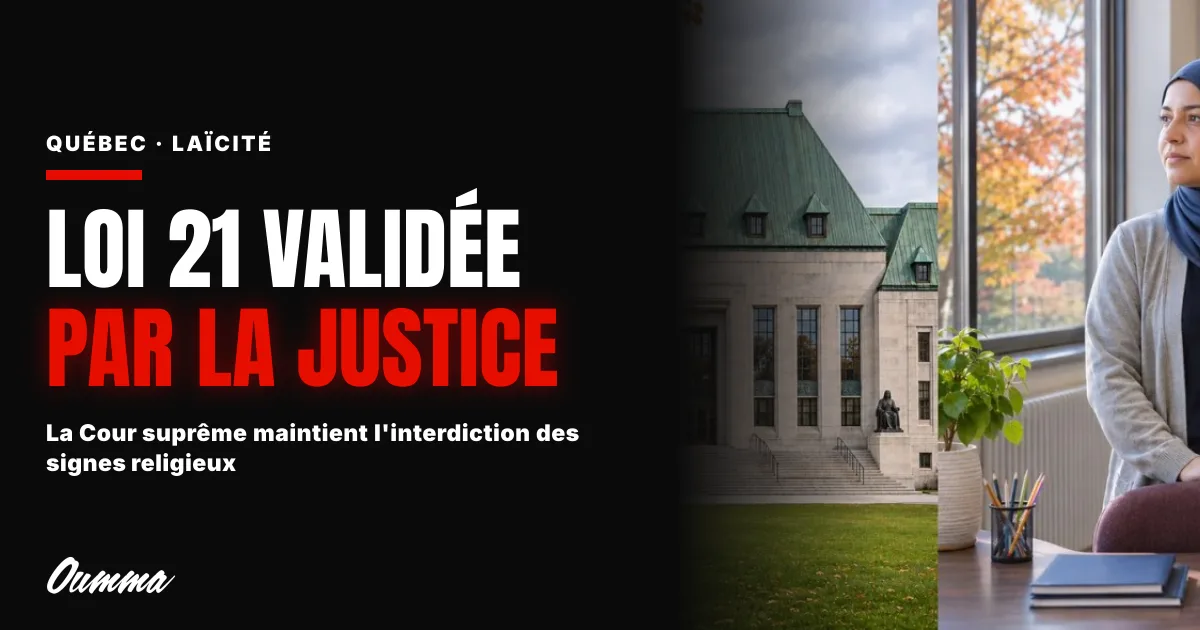
Quebec: Law 21 validated by the Supreme Court of Canada
In its judgment of November 27, the Supreme Court of Canada, the highest court in the country, validated most of Quebec’s law on secularism. The ban on wearing religious symbols remains in force for several professions, including public school teachers and police officers. For Muslim women who wear the hijab, this ruling maintains a restriction that may prevent them from accessing certain jobs or changing positions.
Why the judges upheld the ban
Adopted on June 16, 2019, the Law on State Secularism, known as “Law 21”, enshrines the religious neutrality of the State in Quebec law. It prohibits people who exercise certain functions from wearing a religious symbol at work. The measure concerns, among other things, the hijab, the Sikh turban, the kippah and the Christian cross. Since 2019, Quebec has relied on section 33 of the Canadian Charter of Rights and Freedoms. This “notwithstanding clause” allows the federal Parliament or a province to apply a law for up to five years, even if it contravenes certain rights guaranteed by the Charter, such as freedom of religion or the right to equality. The measurement can be repeated. Quebec renewed it in 2024 by Law 52. By six votes to one, the judges considered that Quebec had validly used this mechanism.
The Court also rejected the appeal of the English Montreal School Board, which administers English-language public schools. The commission invoked the right of the English-speaking minority to manage its establishments. The judges recognized that the law could limit its recruitment choices, but considered that the infringement of linguistic rights protected by the Charter had not been demonstrated. The summary of the judgment specifies that the Court rejected the obligation to sit with their faces uncovered for Quebec deputies, because it infringed their right to exercise their mandate.
The ruling also specifies what the courts can do when a province uses this clause. They can examine whether a law infringes on any of the rights concerned and, if so, declare it publicly. The law can then continue to apply. In this case, the Supreme Court recognized this power without making a statement about the rights covered by the clause.
In schools, careers under conditions
In the reasons for the judgment, the majority judges note that the people affected are predominantly Muslim women. They point out that the law closes access to certain jobs and can slow down job changes and promotions. This observation sheds light on the effects of the ban in both French- and English-speaking schools.
In December 2021, Fatemeh Anvari, a teacher at an elementary school in Chelsea, western Quebec, was reassigned to other duties because she wore the hijab. The Canadian Press agency then reported that she was still working in the establishment after leaving her class. According to the Associated Press agency, the Prime Minister of Quebec, Paul St-Pierre Plamondon, hailed a victory for secularism on Friday. The British daily The Guardian reported the reaction of Stephen Brown, executive director of the National Council of Canadian Muslims, a rights organization. He believes that the judgment will make it easier for governments to question the rights of minorities.
For a teacher who benefited from the exception reserved for people already in position on March 27, 2019, the government of Quebec specifies the conditions. She can continue to wear her hijab as long as she performs the same function within the same organization. If she accepts a position with another school organization, she loses this protection and must remove her hijab to teach.
Subscribe to the Oumma letter: our articles, our analyzes and our new programs arrive directly in your mailbox.
Free. One-click unsubscribe. Everything you need to know about Umma’s letter
