
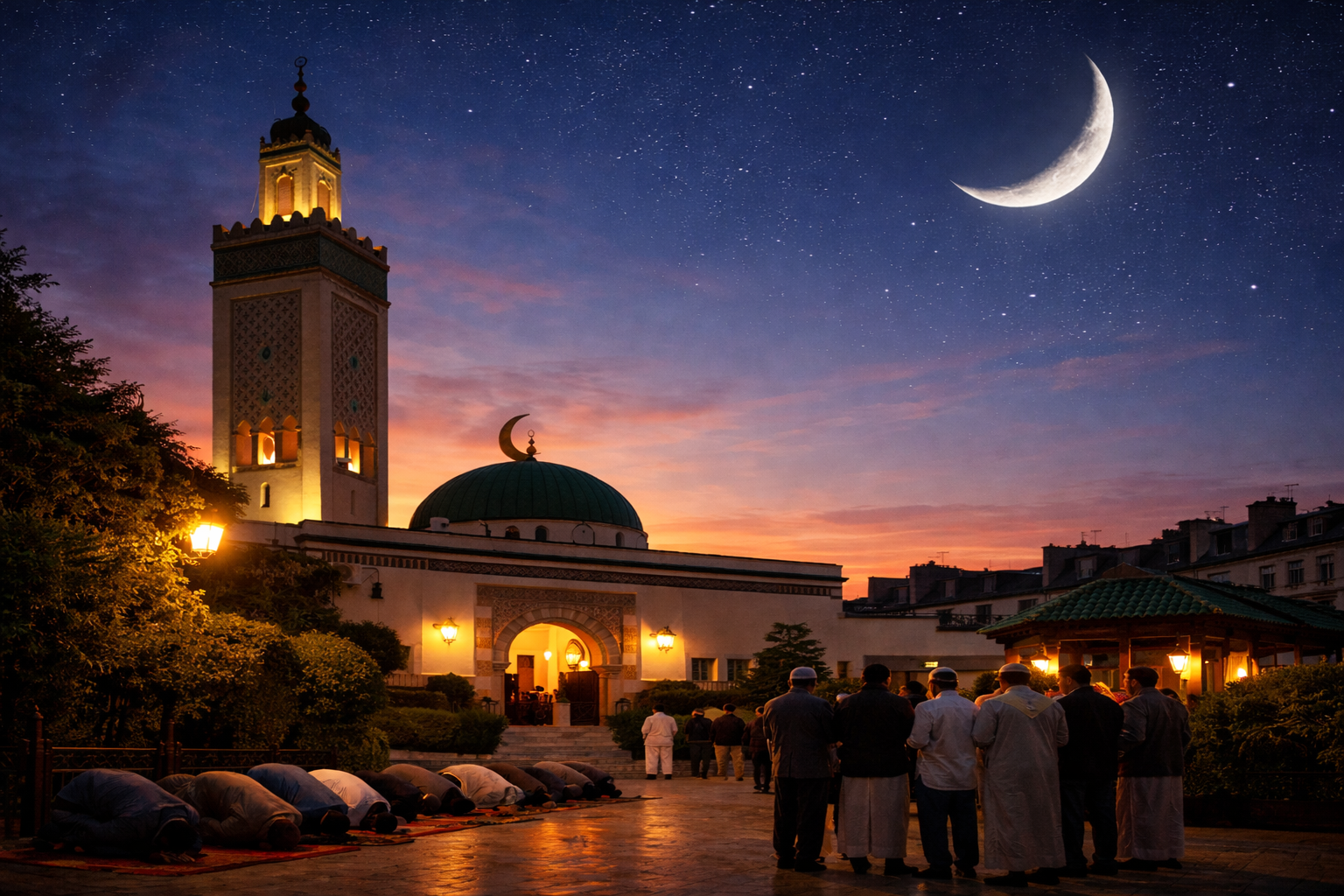
Ramadan 2026 in France: faced with the divergence, Wednesday or Thursday, when should we fast?
- Understand the reasons for this discrepancy.
- Learn to fast with confidence.
- Promote the plurality of opinions within the Muslim community.
As the month of Ramadan approaches, a discrepancy over the start date of fasting has emerged in France, sparking incomprehension, debates and sometimes unnecessary tensions. This article does not aim to decide between positions or fuel controversy, but to offer clear, accessible and calming benchmarks. It is aimed at the faithful who seek above all to fast with complete confidence, without doubting the validity of their approach or questioning that of others. Because plurality of opinions is part of Islamic history, and the month of Ramadan calls for spiritual elevation much more than division.
Start of Ramadan 2026: understanding the divergence to fast with confidence
As the month of Ramadan approaches, many Muslims in France find themselves faced with a confusing situation this year: two different dates have been announced for the start of the fast. For some, Ramadan begins on Wednesday February 18, 2026, for others on Thursday February 19, 2026.
This divergence, widely commented on on social networks, has given rise to questions, concerns and sometimes excessive reactions. However, far from the controversies, it is possible to calmly understand what is at stake — and above all to know how to fast with complete peace of conscience.
Two official announcements, two recognized methods
In France, two major authorities have communicated:
-
There Great Mosque of Paris announced, at the end of the Night of doubt organized on February 17, 2026, that Wednesday February 18 marks the first day of the month of Ramadan.
-
THE French Council of Muslim Worship (CFCM) maintains that Thursday February 19 is the first day of Ramadan 1447H, based on astronomical data relating to the visibility of the lunar crescent.
It is essential to emphasize this: both instances are based on serious religious foundations. The divergence does not relate to faith, nor to scientific data, but to the legal method adopted.
Vision of the moon and astronomical calculation: a false opposition
The Prophet ﷺ said: “Fast from his vision and break from his vision. » For centuries, Muslims naturally used eye observation to determine the entry of the month. Not because this method was sacred in itself, but because it was the means available at the time. Today, astronomical calculation has become a reliable, precise and widely used tool. It makes it possible to achieve the desired objective: certainty, without depending on climatic hazards or exposing the community to avoidable errors.
The Quran also recalls: “The sun and the moon move according to a precise calculation. » (55:5)
The question is therefore not to oppose science and religion, but to understand how different means can serve the same spiritual purpose.
Why this divergence specifically this year?
In 2016, an international congress bringing together theologians and astronomers from the Muslim world proposed a unified Hijri calendar, based on astronomical calculation. This principle was applied for several years in Europe, Turkey and North America without major difficulty. But in 2026, a rare and exceptional astronomical configuration led certain authorities to activate particular conditions provided for by this calendar, resulting in two distinct legal readings, both coherent and argued. This divergence is neither new nor worrying: it is part of an ancient legal tradition, known and accepted by Muslim scholars.
What should the faithful actually do?
This is the central question. The answer is simple: fasting is valid in both casesas long as it is based on a recognized religious opinion and a sincere intention.
In practice, the most soothing attitude consists of:
-
follow his mosque,
-
or the religious body that we usually follow,
-
and to preserve family and community cohesion.
Islam values harmony and wisdom. Transforming a legal divergence into a source of suspicion or rupture goes against the very spirit of Ramadan.
Divergence as spiritual wealth
The legal schools of Islam have coexisted for centuries despite their differences, without this ever weakening the unity of the community. Even today, in the same city, mosques can adopt different references for prayer times. This plurality is accepted. It must also be true regarding the start of Ramadan. What deserves vigilance, on the other hand, are hurtful words, hasty judgments and legitimacy trials.
The Quran reminds us: “Speak good words to people. » (2:83)
This year, Ramadan begins:
-
Wednesday February 18, 2026 for some,
-
on Thursday February 19, 2026 for others.
Both positions are based on serious religious reasoning. The main thing is not to convince, but to live this blessed month with sincerity, humility and kindness.
May this Ramadan be a time of contemplation, appeasement and rapprochement — and not of division.
