
Report highlights key role of Muslim generosity in supporting UK public services
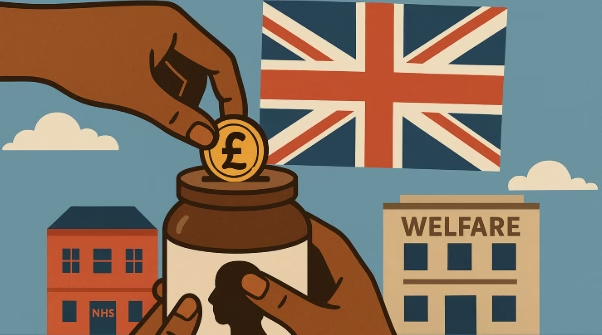
A report from Equi, an independent body specializing in the analysis of public policies, shows that the solidarity of British Muslims plays an increasingly central role in maintaining the country’s public services.
The study estimates that their donations reach 2.2 billion pounds (around 2.6 billion euros) per year, a level four times higher than the national average. This financial commitment eases the pressure on already weakened public services, whether the NHS, local authorities or social protection systems. Muslim associations intervene in various areas: housing assistance, food distribution, emergency relief, psychological support, etc.
In 2023, the work of the National Zakat Foundation would have made it possible to avoid evictions which would have cost municipalities nearly 29 million pounds. Every pound invested by the organization would have generated up to 73 pounds of savings for the public sector. The study also notes a generational change: young Muslims are directing their donations more towards British social issues such as child poverty, mental health or the increase in homelessness.
Despite this impact, Muslim organizations still have to deal with significant obstacles – de-banking, rigid financing rules, surveillance systems – as well as weak institutional recognition. For Equi’s director, Professor Javed Khan, this generosity constitutes “a safety net for public services” and requires more serious cooperation from the government.
This report clearly shows that an entire section of social action in the United Kingdom today relies on the mobilization of Muslim citizens. In a context where the State is reducing its capacities, this generosity fills gaps that institutions struggle to take care of. However, the actors who provide this decisive assistance often remain invisible or hampered by administrative obstacles. Fully recognizing their role and creating bridges with public authorities would not only improve the effectiveness of social services, but also strengthen national cohesion in a period of strong economic tensions.
