
Reza Pahlavi, an opponent without a people, supported by Trump and Netanyahu
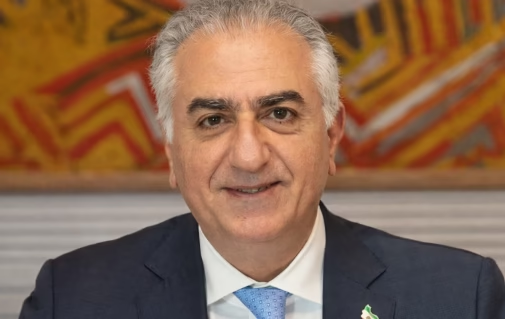
Reza Pahlavi, a media figure supported by the West, lacks popular support in Iran.
WHY READ:
- Analysis of Reza Pahlavi’s media construction.
- Examining its monarchical heritage and foreign support.
- Reflection on Iranian sovereignty and the future of the country.
A media figure shaped by the West
Presented by many Western media as a “credible” alternative to the Iranian regime, Reza Pahlavi appears above all as a media construct intended for television sets, think tanks and international editorials. Its disproportionate visibility outside Iran contrasts brutally with its almost total lack of popular support inside the country. Since exile, he has multiplied interviews, conferences and forums, without ever relying on a real political organization, a structured social movement or an activist base rooted in Iranian society.
This status as a media figure is not innocent. It reveals a well-known logic: when a people challenges a regime hostile to Western interests, the West hastens to designate in its place an “acceptable” opposition, smooth and compatible with its own geopolitical agendas. Reza Pahlavi embodies this ideal profile: monarchical heir, perfectly Westernized, speaking the language of chancelleries and the dominant media. He is the candidate from the outside, much more than that of the Iranians.
A monarchical heritage inseparable from repression
Reza Pahlavi remains inseparable from the regime of his father, Shah Mohammad Reza Pahlavi, whose fall was the product of massive popular rejection. The Iranian monarchy was an authoritarian system, based on political violence, corruption and strategic submission to Western powers. The SAVAK, the infamous political police, embodied this brutality: torture, arbitrary arrests, widespread surveillance and systematic elimination of opponents.
This past is not an abstract academic debate. It constitutes a traumatic memory still alive for millions of Iranians. The 1979 revolution was not an accident of history, but an insurrection against an imposed order, brutal and dependent on foreigners. Resurrecting this monarchical figure today under the guise of “democratic transition” reflects voluntary political amnesia, or even assumed contempt for Iranian history.
An opposition under foreign supervision
The Reza Pahlavi illusion dissipates definitively when we examine his supporters. He benefits from the explicit support of Donald Trump, a symbol of uninhibited authoritarianism, contempt for international law and normalized political violence. Such sponsorship is enough to discredit any sincere democratic posture.
Even more serious, Reza Pahlavi displays his closeness to Benjamin Netanyahu, today under arrest by the International Criminal Court for war crimes. This support is not a simple ideological affinity: it places Pahlavi in a logic of strategic alignment and regional confrontation, in defiance of Iranian sovereignty and popular aspirations for self-determination.
Criticizing Reza Pahlavi in no way amounts to whitewashing the current Iranian regime. Authoritarian, repressive, corrupt and economically asphyxiated, it is going through a deep crisis. The repeated popular mobilizations, led by women and youth, demonstrate a massive and irreversible rejection.
But the end of an oppressive regime never justifies imposing on the people an alternative manufactured from outside.
Sovereignty cannot be negotiated
One thing remains obvious: the future of Iran belongs to the Iranians, and to them alone. Neither Washington, nor Tel Aviv, nor Western editorial offices are legitimate in appointing the representatives of a people. Reza Pahlavi only represents an above-ground project, thought of elsewhere, for other interests. At a time when the regime is faltering, the challenge is not to recycle figures from the past under foreign supervision, but to finally let the Iranian people decide freely, without interference, on their political future.
According to Pouria Amirshahi, Reza Pahlavi is an imposter, dubbed by Trump and Netanyahu. pic.twitter.com/RiJytMceUN
— Oumma.com (@oumma) January 12, 2026
