
Saudi Arabia – Venezuela: oil, or the selective indulgence of the West
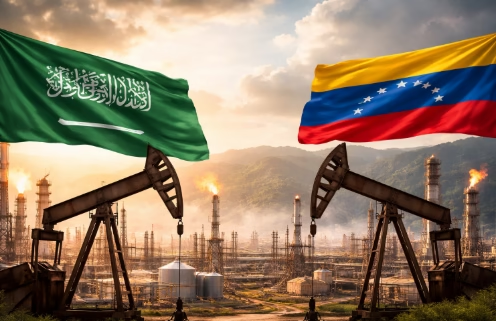
Oil doesn’t just shape global markets. It also influences, in a very concrete way, the way in which political regimes are judged, tolerated or fought. The comparison between Saudi Arabia and Venezuela highlights a reality that is difficult to ignore: democratic principles and human rights become variable when Western energy interests are at stake.
Saudi Arabia: an authoritarian regime protected by its oil
Saudi Arabia is one of the world’s major energy powers. This central position, however, is based on a political system which leaves little room for doubt: the kingdom is an absolute monarchy, without free national elections, without real political pluralism and without freedom of expression worthy of the name. Opponents are imprisoned, critical voices silenced, unions non-existent. Women have certainly obtained certain rights in recent years, but these advances remain strictly controlled by an authoritarian power which does not tolerate any dispute. Despite this, Saudi Arabia remains a privileged partner of Western powers. The reason is simple: its central role in the world’s oil supply. Thanks to Saudi AramcoRiyadh can stabilize markets or, on the contrary, cause price tensions.
This ability gives the kingdom a form of political immunity. Human rights violations are mentioned, sometimes verbally condemned, then quickly eclipsed by the imperatives of “stability” and “energy security”.
Venezuela: oil as an instrument of sovereignty… and confrontation
Venezuela has followed a radically different trajectory. Since the Chavista era, oil has been seen as a tool of national sovereignty, intended to finance social policies and break with historical dependence on Washington. This orientation quickly placed Caracas in a position of direct confrontation with the United States. The public company PDVSA has been targeted by severe sanctions, depriving the country of access to markets, technologies and investments necessary for the exploitation of its resources.
The result is known: collapse of production, major economic crisis and brutal impoverishment of the population. Oil, supposed to guarantee independence, has transformed into a factor of extreme vulnerability.
Recognize the authoritarian nature of the Maduro regime, without justifying illegality
However, it would be dishonest to ignore the political reality of current Venezuela. Nicolás Maduro leads an authoritarian regime, marked by the concentration of power, repression of the opposition and a serious deterioration of democratic institutions. Recognizing this fact is essential for any serious analysis. But this in no way justifies his kidnapping, nor the extrajudicial methods used against him. The denunciation of authoritarianism cannot serve as a pretext for practices which violate international law and reinforce the law of the strongest.
Here again, the contrast is striking: some authoritarian leaders are captured or sanctioned, while others, just as repressive, benefit from tacit protection because of their strategic usefulness.
These imbalances are found even in OPEC. Officially, all producing countries are equal. In practice, Saudi Arabia largely sets the pace, supported by its production capacity and its international alliances. Venezuela, weakened and isolated, pleads for higher prices in order to preserve its revenues, but without having the political or technical means to really make an impact. OPEC then appears less as a space of solidarity than as a reflection of global balance of power.
Oil, authoritarianism and Western hypocrisy
The Saudi case reveals a central contradiction in Western discourse. Human rights are held up as a universal value, but applied in a deeply selective manner. As long as oil flows, arms contracts multiply and markets remain under control, the absence of democracy becomes secondary. This complacency fuels deep resentment in many regions of the world, where international morality appears conditioned by economic interest.
In Venezuela, sanctions and the oil collapse have plunged millions of people into precariousness and exile. In Saudi Arabia, oil revenue fuels the power of the state and elites, without offering citizens real political rights. In both cases, oil serves above all to consolidate regimes, much more than to emancipate populations.
The comparison between Saudi Arabia and Venezuela lays bare a disturbing truth: in the global oil order, democracy is negotiable. Regimes are not judged on their practices, but on their strategic usefulness. As long as this logic dominates, the energy transition will not only be an ecological challenge. It will also remain a political and moral fight, aiming to break with a system where freedoms are conditional and international justice is profoundly unequal.
