
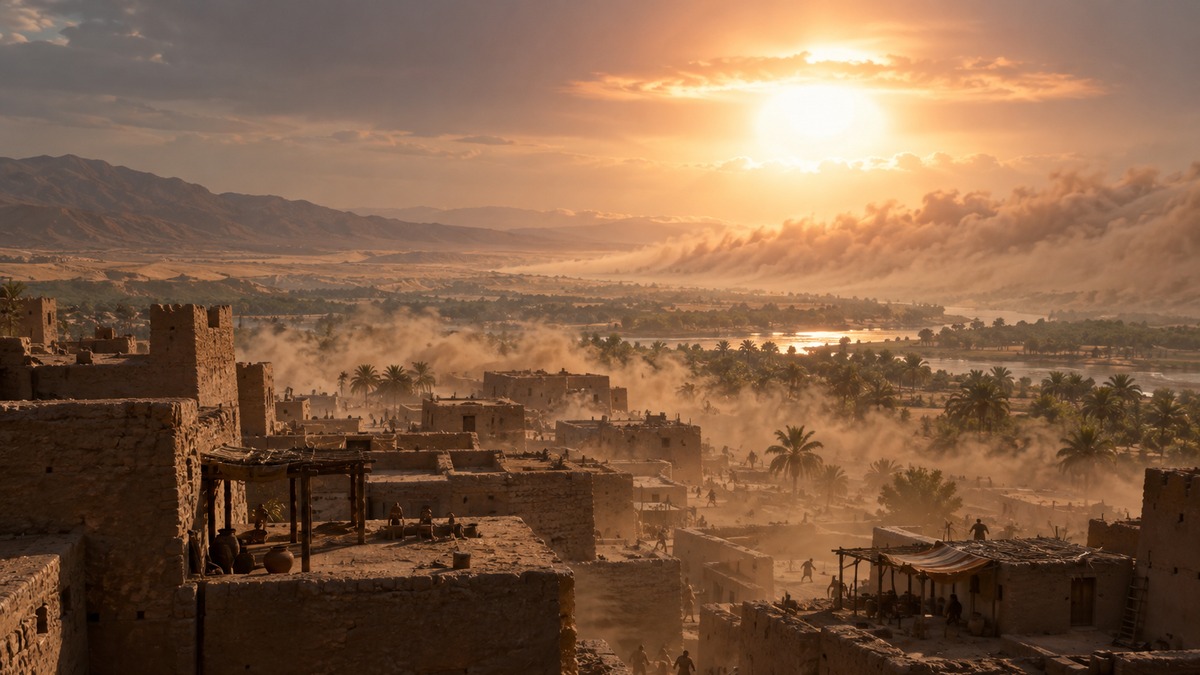
Scientists believe they finally know what destroyed the biblical city of Sodom: a cosmic blast 1000 times more powerful than the Hiroshima bomb
For centuries, the destruction of Sodom has been imagined as fire falling from the sky. A dramatic archaeological interpretation now gives that image a possible natural mechanism: an object from space may have exploded in the atmosphere above an ancient settlement, releasing heat, pressure and debris in a matter of seconds.
The idea does not depend on a crater. In an airburst, a comet fragment or asteroid can break apart before reaching the ground. Most of its energy is released overhead, producing a blast powerful enough to flatten buildings across a wide area. That possibility has made one ruined city in the Jordan Valley central to a debate where archaeology, geology and biblical memory meet.
A city destroyed in an instant
The settlement was not a remote cluster of huts. It was a fortified urban community built from mud brick, with walls, homes and streets supporting a substantial population. Then its ordinary life appears to have stopped abruptly. Structures collapsed, intense heat altered materials and the inhabited area was abandoned.
What makes the destruction unusual is the combination of effects. Ordinary fire can burn roofs, warfare can topple walls and an earthquake can bring down neighborhoods. But a concentrated episode involving extreme heat and a powerful outward force suggests a more complex event.
How an airburst can erase a settlement
A cosmic airburst begins when an incoming object enters the atmosphere at enormous speed. Friction and pressure place the object under forces it may not survive. If it breaks apart, the stored energy is released above the surface rather than underground. The result can be a rapidly expanding wave of heated air followed by intense winds.
At close range, wooden beams and crops could ignite. Mud-brick walls might crack or be pushed sideways. Small particles could melt, fuse or travel through the air before cooling. Altitude, angle and terrain would shape the blast rather than leave a neat circular boundary.
The comparison with a nuclear explosion communicates the scale, but the processes are not identical. A natural object would not produce the same radioactive signature. What they share is the sudden conversion of immense energy into heat, light and pressure.
Why salt may have prolonged the disaster
The Jordan Valley landscape adds another layer to the scenario. A powerful explosion near salty water and mineral-rich ground could have thrown fine material across fields and settlements. Even communities outside the central blast area might then have faced damaged soil, contaminated water and failed harvests.
That could explain why destruction was followed by a long interruption rather than immediate rebuilding. If the surrounding agricultural system had also been ruined, returning to the same place would have offered little advantage.
This wider environmental effect also fits the lasting memory of a region rendered hostile. A single brilliant flash would have been terrifying, but years of barren fields and displaced families would have carried the event across generations. The story remembered later may therefore combine the moment of destruction with the prolonged consequences that followed it.
Where archaeology meets an ancient story
Linking a particular ruin to biblical Sodom is the most difficult step. Ancient texts, later traditions and modern maps do not always point neatly to the same location. A destroyed Jordan Valley city can resemble elements of the narrative without proving that it was the city named in scripture.
That distinction matters because the scientific question and the historical identification are separate. Researchers can examine whether a settlement experienced extraordinary heat and pressure. They can test whether the destruction happened suddenly and whether the region was abandoned. Deciding whether survivors’ memories eventually shaped a specific religious account requires a different kind of argument.
A natural event with the force of legend
The airburst hypothesis is compelling because it turns several strange clues into one coherent sequence. A bright object enters the sky, detonates overhead, destroys a city, spreads heated debris and damages the surrounding land. Survivors would have had no vocabulary for asteroids or shockwaves. They would only have known that fire and devastation appeared from above.
That does not settle every question about Sodom or transform an ancient narrative into a modern incident report. It offers a possible bridge between physical evidence and catastrophic memory. Whether or not the ruined settlement receives the biblical name, its sudden end shows how quickly forces beyond human control could change the ancient world.
