
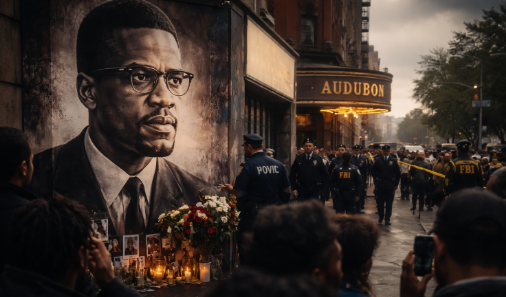
Sixty years after the assassination of Malcolm X: his family sues the NYPD and the FBI
Sixty years after the assassination of Malcolm Xthe battle for truth enters a new phase. His daughters have filed a lawsuit in New York federal court to shed light on the alleged role of Federal Bureau of Investigation (FBI) and New York City Police Department (NYPD) in his murder — and in the cover-up that allegedly followed.
On February 21, 1965, the African-American leader was shot dead at the Audubon Ballroom in Harlem as he prepared to speak to the Organization of African-American Unity. He was 39 years old, lived in Queens with his wife and four daughters, and worked to internationalize the fight against racism in the United States, notably by taking the matter to the United Nations.
A leading legal team
To file this historic complaint, the family surrounded itself with experienced lawyers in matters of police violence and civil rights. Among them, the Chicago lawyer Flint Taylorknown for his work on the assassination of Fred Hamptonemblematic figure of the Black Panthers killed during a police operation in 1969.
According to Taylor, Malcolm X was targeted as part of a federal strategy to neutralize leaders capable of unifying and energizing black nationalist movements. A logic already at work against other radical organizations of the time, monitored and infiltrated by the federal services.
A weakened official version
For decades, the commonly accepted story was that members of the Nation of Islam — a religious movement led by Elijah Muhammad — acted alone, against the backdrop of an ideological break with Malcolm X.
But this version has been seriously shaken. In 2020, the documentary series Who Killed Malcolm restart the case. In the process, a joint reinvestigation led by the Innocence Project and the Manhattan district attorney’s office resulted in the exoneration of two wrongly convicted men, Muhammad Aziz and Khalil Islam. New York City paid them $26 million in 2022, while the case against the FBI remains ongoing.
Declassified documents have revealed gray areas: presence of informants, close surveillance, elements hidden from the defense. The name of William Bradley, a member of a Newark mosque, comes up repeatedly as the man who fired the fatal shot. Evidence suggests he may have been linked to federal services.
The heart of the dispute: concealment
The complaint filed by the family claims that the authorities not only failed to prevent the assassination: they helped create the conditions for it to take place, then covered up the real responsibilities. The FBI is now invoking the statute of limitations – three years – to try to have the case closed. The lawyers counter that this prescription cannot apply when the facts have been deliberately concealed, depriving the family of their fundamental right to an effective remedy.
The documents recently transmitted by the authorities, often heavily redacted, on the contrary fuel suspicions of a state secret maintained for six decades.
The elected mayor of New York, Zohran Mamdaniis now being questioned: will he open all of the municipal archives linked to the affair, or will he perpetuate a 60-year-old institutional silence? Beyond financial compensation, the family is also demanding public and educational recognition. She wants the full story of the assassination to be taught in New York public schools, similar to what was achieved in Chicago regarding police crimes linked to the Hampton affair.
For those close to Malcolm X, it is not just a legal battle: it is a demand for restorative justice. Lift the veil on the truth, repair symbolically and materially, and restore one of its darkest pages to American history. Like many revolutionary figures, Malcolm X has been transformed into a harmless icon: his face even appears on an American postal stamp. Yet his ideas — black consciousness, self-determination, international solidarity, independence from dominant parties, the right to self-defense — continue to inspire.
At a time when debates on structural racism, police violence and historical memory are sweeping across the United States, the complaint filed by her daughters reactivates a fundamental question: can we build a solid democracy on buried truths?
Sixty years after the Harlem shootings, American justice is faced with its own past.
