
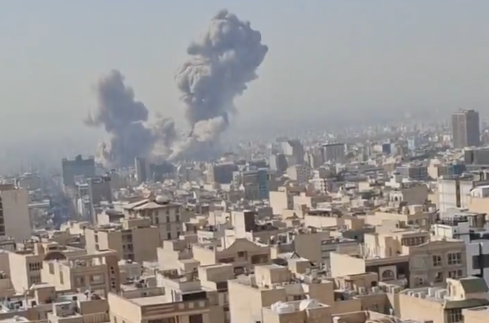
Strikes by the United States and Israel against Iran: an illegal escalation at the risk of regional chaos
A military escalation at dawn: Israeli and American strikes as an imperial act
This Saturday morning, before dawn, several detonations were heard in the Iranian capital as well as in other major cities, including Isfahan and Qom. According to official statements, military installations, command centers and infrastructure linked to Iranian ballistic capabilities were targeted by coordinated Israeli and American strikes. Washington confirmed its direct participation in the operation, presented as having been planned for a long time alongside Israel.
It must be pointed out bluntly: these Israeli and American strikes constitute an assumed imperialist aggression. Behind the technocratic vocabulary of “targeted strikes” and “preventive strikes” are two military powers which have chosen to impose their will by force, without a collective mandate, by bypassing the mechanisms of international law. A few hours later, Tehran announced a response. Missiles were fired towards Israeli territory, triggering the activation of defense systems and warning sirens. Israeli airspace was temporarily closed and the region entered a state of high alert. In just a few hours, the Middle East has crossed a new threshold in the escalation caused by these Israeli and American strikes. US President Donald Trump spoke of “major combat operations”. For his part, Iranian Supreme Leader Ali Khamenei denounced “aggression” and promised a firm response.
But the initial initiative remains that of Israeli and American strikes. They are the ones who opened the cycle of direct confrontation and imposed the military tempo.
An authoritarian regime… and Israeli and American strikes in violation of the law
Yes, the Iranian regime is authoritarian. Political freedoms are restricted, the opposition is controlled, the independent press is under pressure and protests are severely repressed. These realities are documented and must be denounced.
But theIran is reduced neither to its regime nor to a homogeneous entity. It is a country of nearly 90 million inhabitants, crossed by a plurality of ethnic groups, languages and identities. While the majority of the population is Persian and speaks Farsi, significant Azeri communities live in the northwest, Kurds in the west, Arabs in Khuzestan, Baloch in the southeast, as well as Turkmens, Armenians and other historical minorities. This human mosaic forms a complex social fabric, sometimes fraught with tensions, but deeply rooted in a common national history.
Bombing such a country means hitting a diverse society, fragile in its internal balances, and not a monolithic bloc. No state, even authoritarian, can be bombed at the whim of a coalition determined to reshape the regional balance. The Israeli and American strikes have no clear legal basis. The United Nations Charter prohibits the use of force against a sovereign state, except in self-defense in the face of an ongoing armed attack or with explicit authorization from the Security Council. However, no resolution authorized these Israeli and American strikes.
The notion of “imminent threat” put forward to justify these Israeli and American strikes is a unilateral assessment transformed into a strategic pretext. If this doctrine were to impose itself, then each power could arrogate to itself the right to strike a country by invoking its own definition of danger. The Israeli and American strikes thus set a dangerous precedent: that of a self-proclaimed right to war.
A brutal display of Israeli-American domination
These Israeli and American strikes do not constitute a simple “show of force”. They are a brutal demonstration of domination, designed to remind the entire region who has military superiority and who is authorized to use it without a mandate. Far from being an isolated episode, the Israeli and American strikes are part of an assumed strategy of containing and weakening Iran. The message addressed to regional actors is clear: any challenge to the security architecture desired by Washington and Tel Aviv could be sanctioned by force.
Several Western officials have raised, openly or half-heartedly, the prospect of a regime change in Tehran. If this is the strategic horizon underlying Israeli and American strikes, then we are no longer in prevention but in interference through military coercion. By claiming a “rules-based international order” while carrying out Israeli and American strikes without a UN mandate, Washington and Tel Aviv are exhibiting a clear double standard.
This Israeli-American demonstration does not only seek to weaken Iran; it aims to set in stone a regional hierarchy based on military superiority and diplomatic impunity.
The risk of caused chaos
Weakening a state as vast and composite as Iran through Israeli and American strikes, without an inclusive political perspective, amounts to playing with a regional powder keg. In a country where several major ethnic and cultural components coexist, any brutal destabilization can awaken peripheral tensions, fuel identity divides or fuel centrifugal logics.
The recent history of the Middle East shows that external interventions, often justified by security imperatives, have led to dynamics of fragmentation, militias and prolonged conflicts. There is no guarantee that Israeli and American strikes will produce the stability they claim to defend. On the contrary, they could open the way to lasting instability, for which civilian populations would pay the price.
Iran occupies a central strategic position between Iraq, Afghanistan, Pakistan, the Caucasus and the Gulf. Any major destabilization caused by Israeli and American strikes would have immediate repercussions across the entire region. In an international context already marked by the war in Ukraine and the genocide in Gaza, adding a direct confrontation resulting from Israeli and American strikes further weakens collective safeguards.
