
The British daily The Telegraph highlights the historical contribution of Muslims to Europe
In an article from Telegraphjournalist Noel Malcolm analyzes Muslim Europethe new book by British author Tharik Hussain, devoted to the imprint left by Muslim civilizations on the European continent. Hussain, son of Bangladeshi immigrants and a practicing Muslim, undertakes a wide journey in the Mediterranean in order to document the material and cultural vestiges of more than eight centuries of Islamic presence.
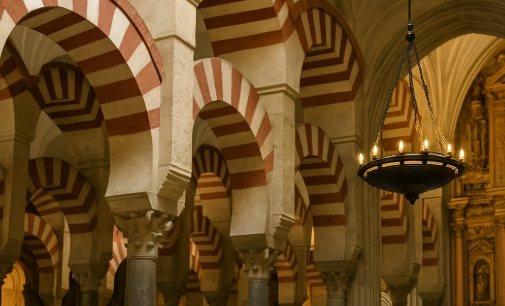
THE Telegraph underlines that the investigation begins in Cyprus before continuing in Sicily, Malta, Portugal and finally in Andalusia, the last great center of Muslim civilization in Europe until the fall of Granada in the 15th century. The author highlights traces that are often overlooked, such as churches built on the plan of ancient mosques or architecture mixing Christian and Mudejar influences.
Noel Malcolm reminds us that the work is not limited to historical or archaeological aspects: Hussain relates numerous meetings with local Muslims – imams, intellectuals or simple faithful – who testify to the religious and cultural continuity between past and present. It also describes the spiritual practices observed on site, whether prayer or dhikr, rarely mentioned in mainstream Western literature. THE Telegraph note, however, that certain anecdotes relayed by the author are based on popular stories difficult to verify, such as the supposed existence of companions of the Prophet buried in Cyprus or the legend of a relative of Muhammad whose tomb was allegedly covered by three miraculous stones. Noel Malcolm also mentions the spread of old rumors, in particular that claiming that the current King Charles would have embraced Islam, without established historical basis.
Despite these reservations, the British daily believes that Hussain’s central objective remains educational: to recall that Muslim civilization strongly contributed to the intellectual and scientific development of medieval Europe. The book particularly emphasizes the medical advances of Muslim Andalusia, where surgeons performed Caesarean sections and cataract operations while the rest of the continent remained immersed in rudimentary practices.
For Noel Malcolm, the work also aims to offer new generations of European Muslims a historical story in which they can be part. Hussain believes that recognizing this continuity will allow children of immigrant families to develop a stronger sense of belonging to their adopted European country. THE Telegraph concludes, however, with a question: if this cultural revaluation can contribute to a better understanding of common history, it will perhaps not be enough in itself to counter the rigorist visions which seek to oppose Islam and modernity.
