The divine in Turkish-Iranian poetry in Islam
Turkish-Iranian poetry in Islam reveals a spiritual depth often obscured by superficial interpretations of religion.
WHY READ:
- To discover the richness of Turkish-Iranian mystical poetry.
- To understand the universality of the spiritual message beyond cultural boundaries.
- To explore the transformation of religious concepts through poetry.
A poor understanding of religion tends to reduce it to social codes, religious morality, practical rigidity. But beyond the haram-halal dichotomy, the theological splits, beyond hermeneutic circularities… there is perhaps another reality, hidden behind the forms that the believer has learned to conceal.
This universal beauty, suggested by the letters of the Koran, is nevertheless a reality to be experienced beyond the ephemeral phenomena of the material world.
Truth itself has described itself as external, Zahir or as internal: Batin: “ We will show them our signs both in the universe and in them‑same » (Quran XLI, 53). This Unique Truth was the breath, the source of the creation of all worlds, of night and day, of the sky and the sea. This breath, whose unveiling of the soul and the veiling of the Ego allow us to grasp the subtleties (اللطيف), materially translates the Truth.
It is in the universality of this message that people, men and women, with radically different cosmogonies, will unite and work in synergy to bear the fruits of this inner culture, brought by the Message of the Creator.
From a historical point of view, this flame has been magnificently sublimated by poets and “mystics” (عارفين) from the Turkish-Iranian world. The cultural, poetic, aesthetic and scientific wealth of this world is intrinsically linked to relationships with their cultures, even prior to Islam.
By “Turkish-Iranian world”, we must understand a group of Iranian peoples in the ethnolinguistic sense (including in particular Kurds, Afghans, Tajiks, etc.) and Turkish peoples, understood here as all speakers of Turkish languages according to historical anthropology (Uzbeks, Azeris, Kyrgyz, etc.), and therefore not exclusively Anatolian.
This space is characterized by deeply intertwined historical trajectories: the Seljuks ruled Iran, while the Ottomans integrated Persian as a court language. From Samarkand to Tabriz, architecture, poetry and thought bear witness to this cross-fertilization.
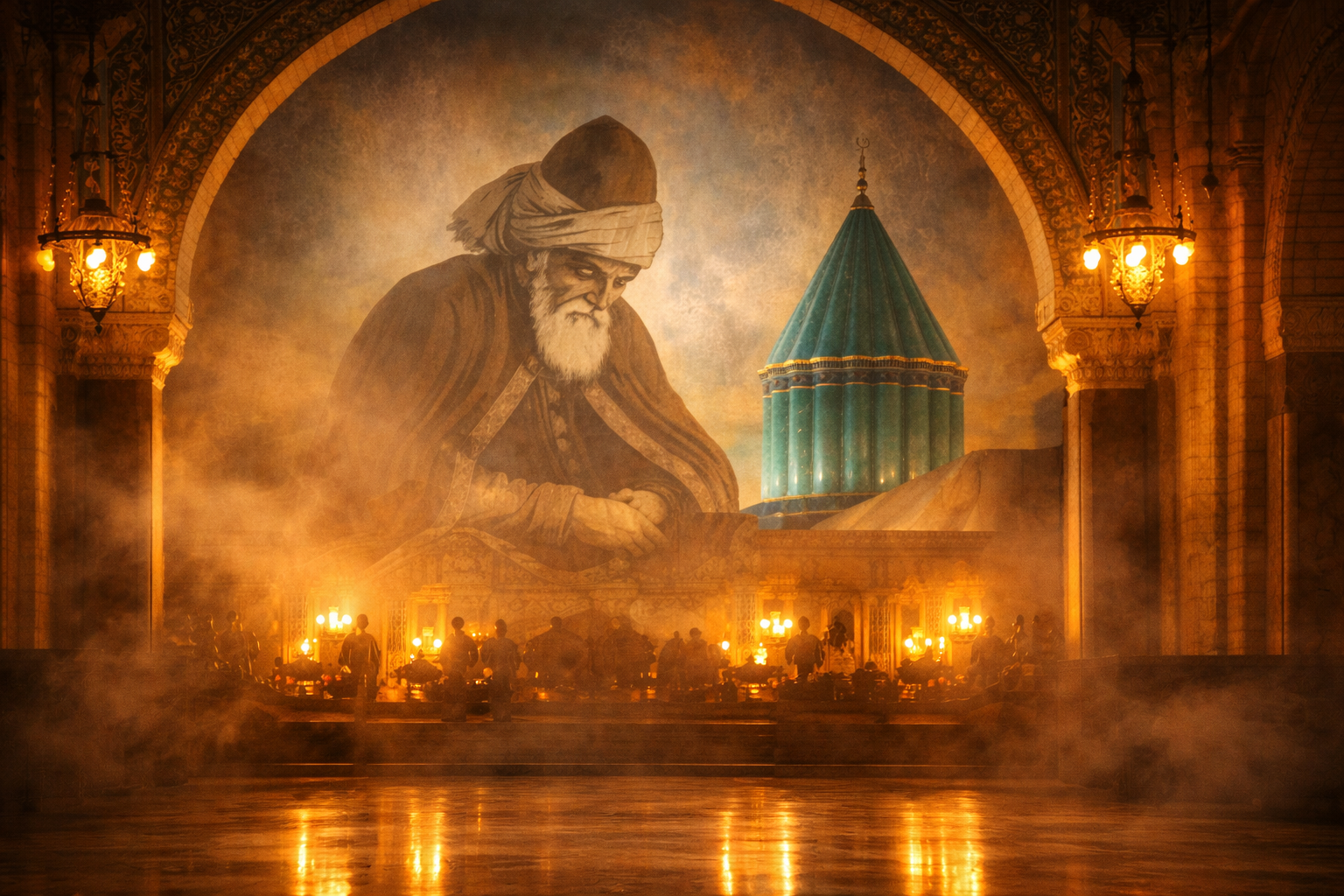
It was there, in this civilizational crucible, that exceptional poetic and philosophical figures were born: Attar of Nichapour, Saadi and Hafiz of Shiraz, Yunus Emre and Pir Sultan Abdal in eastern Anatolia. But the one who perfectly embodied this cultural junction was Mevlana Rumi, born in Balkh in a Persian environment (Afghanistan) and died in Konya in the Turkish world (Turkey).
This anthropological foundation allowed the deployment of an interior poetry (باطني), distinct from the productions of other peoples. Muslim spirituality was crowned by this largely Iranian contribution. A mystical tradition consisted of seizing divine language through the Koran to speak of God, an intimate and casual relationship, contrasting with certain literalist exegetical traditions historically dominant in the Arab-Semitic world. Beyond this difference between Iranian and Arab imaginations and cultures, a unique link was created between the letters of the liturgical language and the Iranian spirit.
Arabic, through its spiritual epistemology, was enriched by the Iranian imagination,
The metaphor took shape: the restoration of the figurative meaning freed the word from its form. Rihla (رحلة), concrete journey in Arabic, became the ultimate journey, the journey of the soul.
El Haqq (الحق), initially debt or relative truth, designated the ultimate Truth, the Creator.
El Huzur (الحضور), physical presence, was transformed into interior presence, fullness.
El Aşk (العشق) is no longer reduced to human love but encompasses the Love which binds the Creator to his creation, and the state which underlies creation and the universes.
These three terms, present in the Arabic, Persian, and Turkish languages, highlight the porosity of languages in the face of a universal underlying message. In this poetry rich in symbols, these poets touched the universal, capable of moving an American as well as an Indian. Its strength lies in suggestion, the gradual unveiling of truth, rather than in clear assertion or concrete description. The ultimate Truth is not described; it resonates through the ineffable. Without symbolism, it freezes, and formal reality dries up
Some factual examples masterfully illustrate this ode: Attar of Nichapour: in The Song of the Birds, the birds cross seven valleys to find the Simurgh (large colorful bird from Iranian mythology, here symbolizing God). The valleys represent the stages of the inner journey: quest, love, detachment and above all el Fana (annihilation of the ego). At the end, 30 birds remain: si‑morgh (which means 30 birds in Persian), the King bird was in them, symbol of divine truth, in each of the Beings.
Al-Halladj: with his misunderstood “أنا الحق” (I am the Truth) expresses the integration of the principle of Tawhid and the stripping of the Ego, not an egoistic affirmation.
rumi: قلبي” (I went to mosques, churches and temples, but I found God in my heart) shows that the essential thing is not the place but interiority, the purification of the heart.
The allegory of wine (خمر) in poetry batini (interior) in Islam illustrates the intoxication of the soul in the face of God; without it, prayer is “a standing corpse”.
In an inspiring word, he adds: “إن الحروف حجب عن الحق، فاحرقوا الحروف لتصلوا إلى المعنى”: “ burning the letter means going beyond the form to reach the meaning », the essence, beyond the sacralization of the letter, of the text in its scriptural dimension… And finally, we wonder if sacralizing practices, places, texts in their written dimension, is perhaps the greatest sin?
