
The Japanese group Saint Marc is banking on gyukatsu (breaded beef cutlet) to conquer the halal markets
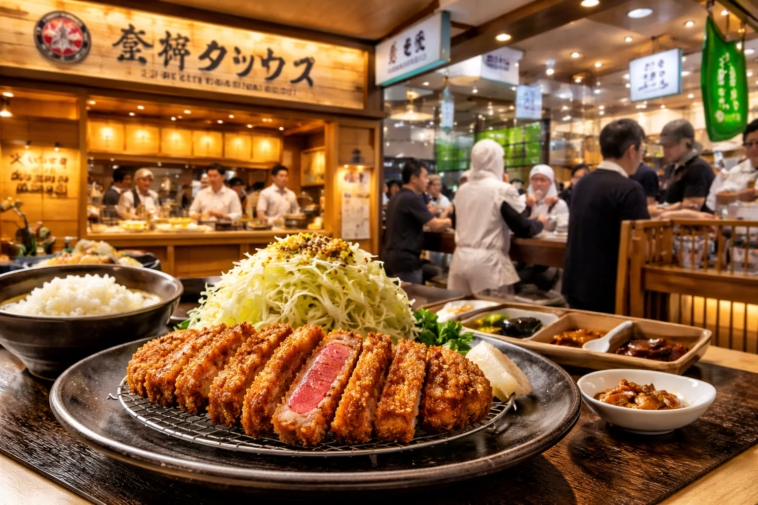
- Discover Saint Marc Holdings’ expansion strategy.
- Understand the growing importance of the halal economy.
- Explore how gyukatsu meets the demands of Muslim consumers.
The Japanese group Saint Marc Holdings, a major player in restaurants and cafes in Japan, is accelerating its international development by betting on gyukatsuthis breaded beef cutlet from Japanese cuisine. The strategy is clear: take advantage of the growing popularity of Japanese dishes while meeting the demands of halal markets, where beef, properly certified, enjoys much wider acceptance than concepts based on pork.
According to information reported by Nikkei, Japan’s leading economic and financial press group, publisher of Nihon Keizai Shimbun – often nicknamed the “Japanese Wall Street Journal” and an essential reference for monitoring companies, markets and industrial strategies in Asia – Saint Marc is targeting 150 restaurants abroad by fiscal year 2030, approximately five times its current international network. An ambition which is part of a broader context: that of the rapid growth of the halal economy, estimated at several trillion dollars on a global scale, and increasingly coveted by large international groups.
A group firmly established in Japan
Founded in 1991 and based in Okayama, Saint Marc Holdings is a company listed on the Tokyo Stock Exchange which has established itself as a key player in the restaurant industry in Japan. The group manages a diverse portfolio of brands, ranging from Western-style bakery cafes and restaurants to chains specializing in pasta, rice dishes and noodles. It operates several hundred establishments on the archipelago, with a strategy based on standardized concepts, easily reproducible and adapted to a family and urban clientele.
Financially, Saint Marc displays a generally stable trajectory. For the 2025 fiscal year, the group achieved a turnover of around 443 million euros, with an estimated net profit of almost 16 million euros. In a Japan faced with an aging population and stagnation in domestic consumption, this solidity is pushing more and more players to look for growth sources abroad, particularly in Muslim countries with strong demographics and an expanding middle class.
Gyukatsu as a lever for international expansion
Expansion abroad is largely based on the acquisitions made in 2024 of the Kyoto Katsugyu and Gyukatsu Motomura chains, for an amount of around 138 million euros. These brands specializing in gyukatsu offer the group already identified brands, but above all a product compatible with halal standards, subject to rigorously controlled supply and certification.
Already present in Indonesia with six establishments, Saint Marc plans to open a first Kyoto Katsugyu restaurant in Malaysia in 2026. These two countries illustrate the heart of the group’s halal strategy: dynamic Muslim markets, where consumers seek international offerings that respect their food standards, without sacrificing quality or the culinary experience.
Beyond the sole case of Saint Marc, this strategy reveals a broader trend: the progressive integration of the halal economy into the globalization strategies of non-Muslim groups. Long perceived as a niche market, halal is becoming a central lever for growth, forcing international players to rethink their supply chains, their certifications and their relationship to local cultures. For Saint Marc, gyukatsu thus appears to be a point of balance between economic adaptation and respect for religious sensitivities, in a sector where credibility has become a key issue.
