The Muslim world: great diversity in the face of the fantasy of the “Muslim peril” – Deconstruction of a geopolitical myth
- To understand the complexity of international relations in the Muslim world.
- To deconstruct the myth of the “Muslim peril” and its implications.
- To explore the real issues of solidarity between Muslim peoples.
The expression “Muslim world” is often used as if it designated a homogeneous bloc, united by religion and animated by a common will. This vision is part of an old and persistent fantasy: that of a “Muslim peril”, presented as a unified entity, ready to conquer the world and seeking to impose its law, its culture and its norms. This story, widely relayed by certain political, media and security discourses in the West, fuels fears, confusion and a deeply biased reading of international relations.
However, this representation does not stand up to analysis of the facts. In reality, the Muslim world is neither homogeneous, nor politically united, nor organized as a coordinated bloc. It is a very diverse group, made up of peoples, societies and States with different trajectories, often with divergent interests. Religion, so important on a spiritual and cultural level, does not in itself structure international relations. The fantasy of a global Muslim threat has more to do with ideology than geopolitical reality.
A common religion does not make political unity
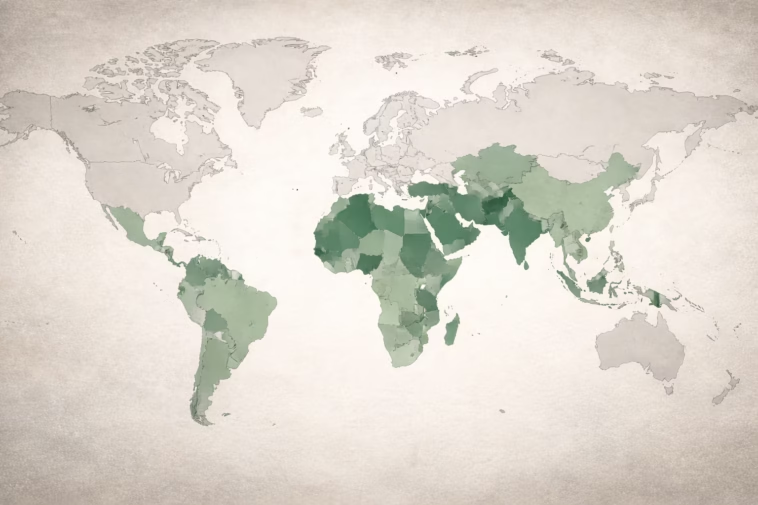
Islam is a global religion, practiced by more than one and a half billion people. But sharing the same faith does not mean sharing the same political vision, nor defending the same choices in matters of governance, public freedoms or international relations. Muslims live in very different countries, with sometimes opposing cultures, languages, traditions and political systems.
Confusing religious community and political unity is a frequent error, often maintained by external discourses which essentialize Islam. States do not make their decisions based on the faith of their populations, but according to their national interests, their internal balances and their regional balance of power. Religion can influence societies or official discourses, but it is not enough to create a common policy based on democracy, freedoms or the rights of peoples.
Profoundly different stories and realities
The Muslim world extends over several continents: Africa, Middle East, Asia, Europe. These regions have very different political histories. Some experienced popular revolutions, others remained under authoritarian regimes or hereditary monarchies. Some societies have been able to conquer areas of public freedom, while others continue to live under strict political control.
Colonial legacies, internal conflicts, economic resources and governance choices have shaped very different national priorities. These gaps explain why the interests of States do not always coincide with the aspirations of people, and why struggles for democracy, justice and fundamental rights occupy a central place in many Muslim societies, often invisible by dominant security discourses.
The interests of States take precedence over the rights of peoples
In international relations, states act above all to preserve their power, security and influence. Alliances, economic partnerships or diplomatic choices rarely meet the democratic aspirations of populations. They are dictated by strategic calculations, often to the detriment of people’s rights.
This reality is regularly masked by a Western discourse which claims to defend stability or the fight against terrorism, while supporting authoritarian regimes in the Muslim world. Religious solidarity is sometimes invoked, but it almost always gives way to economic, military or geopolitical interests, at the cost of serious consequences for public freedoms.
Religion as a political tool, not a moral compass
Religion is not absent from international politics, but it is often exploited. Leaders invoke Islam to strengthen their legitimacy, justify their power or neutralize democratic demands. This instrumentalization sometimes serves to delegitimize popular struggles by reducing them to religious or identity threats.
At the same time, Western security discourses use Islam as a global reading framework, transforming political and social crises into religious problems. This double instrumentalization contributes to fixing the image of a monolithic political Islam, while diverting attention from the real issues: freedom, social justice and the rights of peoples.
The illusion of unity and the limited role of common institutions
The idea of a unity of the Muslim world is often reinforced by the existence of organizations supposed to embody this solidarity, such as theOrganization of Islamic Cooperation (OCI). However, this organization above all illustrates the limits, even the failure, of a political unity based solely on religious affiliation.
Bringing together more than fifty states with very divergent interests, the OIC is most often limited to cautious and symbolic declarations. It struggles to concretely defend the rights of peoples, public freedoms or respect for international law. Internal rivalries, the protection of the regimes in place and the fear of any democratic dynamic largely explain this inertia.
Rethinking solidarity around rights and freedoms
Recognizing that the Muslim world is not politically united does not mean renouncing all solidarity. But this solidarity can no longer be based on a fantasized religious identity. To be fair and credible, it must be based on clear principles: democracy, public freedoms, the rights of peoples, justice, respect for international law, human dignity and the responsibility of States. Such solidarity makes it possible to support people rather than regimes, rights rather than interests, and freedom rather than domination. It breaks with security logics and Islamophobic readings which reduce entire societies to a threat.
Getting away from the myth of the political unity of the Muslim world is essential to deconstruct fear speeches and stigmatization strategies. This allows us to understand that current conflicts are not the product of a religion, but of political choices, structural injustices and international balance of power.
It is on this condition that public debates can gain in lucidity, courage and responsibility, and that solidarity can finally be built around freedoms, justice and the universal rights of peoples.
