
The Saudi fund Zamil Group and AMCE become shareholders of Oumaty
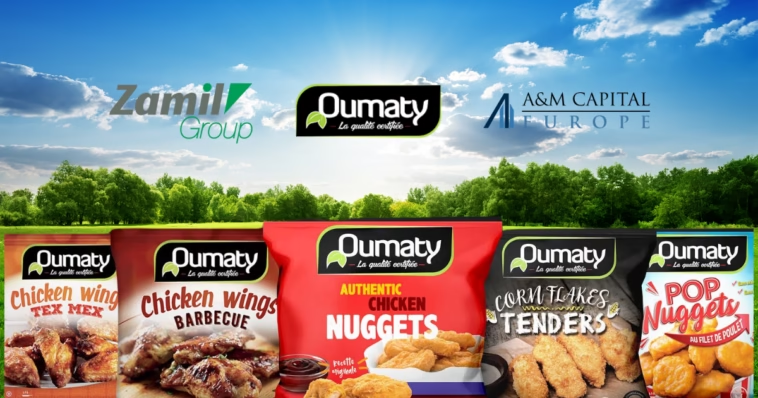
Saudi fund Zamil Group and AMCE become majority shareholders in Oumaty, raising questions about halal commitments.
WHY READ:
- Understand the impact of investment on the halal market in France.
- Discover the ethical commitments maintained by Oumaty.
- Analyze the controversies surrounding halal brands and their implications.
For several months, the halal market in France has experienced notable developments with the entry of international investment funds into the capital of historically established brands. A dynamic can raise many questions within the Muslim community, particularly about maintaining the religious and ethical commitments that underpin this sector.
It is in this context that on Friday January 30, 2025, the Saudi fund Zamil Group and the A&M Capital Europe (AMCE) fund jointly became majority shareholders of the Oumaty brand .
This buyout comes while AMCE already owns, since December 16, 2025, the group Amalricparent company of the brand Isla Délice. The arrival of new financial players in the halal ecosystem thus raises legitimate questions about governance, traceability and the sustainability of the values carried by these brands.
Zamil Group is one of the leading investment groups in Saudi Arabia, owned by the Zamil family, ranked among the country’s richest people. The group made this investment via its private equity structure, alongside AMCE. For his part, AMCE is an independent private equity company, exclusively focused on the European market.
Furthermore, our editorial staff also learned that the acquisition of the company Asia Food, owner of the Oummi brand, by the Amalric group (Isla Délice) was finalized on December 30, 2025.
Contacted by the editorial staff, Eric FauchonCEO of Amalric, specifies that only brand portfolios Oummi and Ital’al are affected by this operation. The other Asia Food brands are not part of the scope of the acquisition.
At the end of 2025, the Isla Délice brand found itself at the heart of a controversy on social networks, following the AMCE fund’s acquisition of a stake in its capital and the circulation of information concerning one of its service providers. Accusations of alleged ties to Israel then emerged. The Isla Délice brand and its CEO, Éric Fauchon, have strongly refuted these allegations. They indicated that no connection exists between the company and Israel, and that the company operates independently, with activities exclusively
Founded in 2014, Oumaty is a French brand of halal products, widely distributed in supermarkets. Since its creation, the brand has highlighted several commitments, including the refusal to mechanically separated meat (VSM)the refusal of stunning by electronarcosis, compliance with slaughter methods consistent with Islamic requirements, as well as halal certification ensured by the organization Achahada.
Management affirms that the operational management of the brand remains ensured by the founding team, strategic and industrial decisions being taken internally, while the co-shareholders are limited to the role of investors without involvement in daily operations.
Asked about the question of halal, central to consumers, management
d’Oumaty affirms that no change is on the agenda. Are in particular
maintained: Achahada certification, slaughter methods in compliance with the rules
Islamic religions, the refusal of VSM as well as that of electronarcosis. According to management,
these commitments were not the subject of any negotiation as part of the buyout.
According to Oumaty’s management, this operation is a good thing for the market
halal and Muslim consumers, as it will allow the brand to expand its
choice of products and increase
Faced with information relayed online reporting possible direct or indirect links with Israel, management is categorical: “Oumaty has no link, direct or indirect, with activities carried out in Israel.” The management specifies that the presence of an international consulting firm, present throughout the world and with offices in particular
Middle East, in the shareholder fund environment has no impact on
the strategy, operational decisions or ethical commitments of the
brand.
The case of the Oumaty brand highlights the transformation of a halal sector that is increasingly embedded in international economic dynamics, while facing Muslim consumers who remain attentive to respecting their religious and ethical convictions. In a context where trust constitutes a major issue, the brand’s management affirms that the arrival of new shareholders alters neither its identity, nor its religious commitments, nor its daily mode of operation.
