
“Traveling alone taught me to trust my inner compass”: the testimony of a Muslim woman who shakes up norms
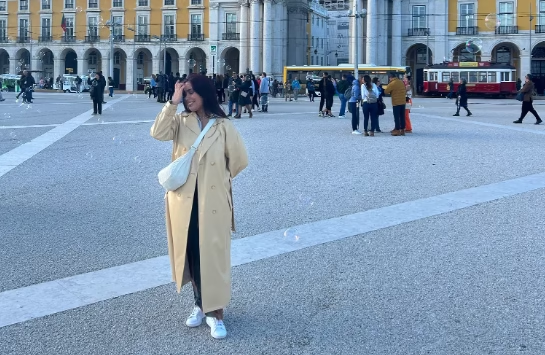
In a story published on the Condé Nast Traveler website — an international magazine dedicated to travel, combining inspiring stories, practical advice and high-end cultural discoveries — journalist Tahmina Begum tells how solo travel profoundly transformed her relationship with the world and with herself. The daughter of South Asian immigrants, long contained by cultural norms and concerns about women’s safety, she describes how her first solo trip, at age 24, offered her a new space of freedom. In Lisbon, between the trams climbing the hills and the pastéis de nata tasted in historic bakeries, she says she found an unexpected sense of belonging.
Her encounters – sellers at the market, Muslim travelers she met along her way – created a spontaneous community where each encouraged the other to push back the imposed limits. Solo travel sometimes remains misunderstood, she notes, particularly because, in some cultural interpretations, it is still expected that a woman travels with a mahram, a close male attendant whose presence is traditionally intended to ensure her protection. Yet, alone, she says she finally hears her own voice: “When I am alone, my heart returns to a normal rhythm. I feel exactly where I need to be. »
Throughout her testimony, Tahmina Begum affirms that the greatest gift of these trips is the new confidence she places in her intuition. For many Muslim women, she emphasizes, exploring the world alone is not a luxury: it is a gesture of autonomy, an essential breath of fresh air — sometimes even a small revolution.
Tahmina Begum’s story highlights a dynamic often overlooked in the dominant travel discourse: when Muslim women travel alone, it is not just a tourist act, but a powerful symbolic movement. They shake up cultural, family and sometimes religious norms diverted from their original meaning. The experience of solo travel then becomes a space of affirmed existence, where a form of calm emancipation is constructed, far from Western clichés of absolute individualism. Begum’s testimony thus reminds us that freedom does not always come through rupture, but sometimes through the simple possibility of walking alone in a foreign city while listening, for the first time, to one’s own inner compass.
