
Trump backs down in the face of Iran: the show of force ends, brutal return to reality
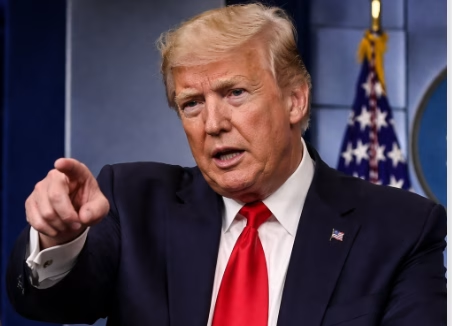
Donald Trump suspends strikes against Iran, revealing a retreat from a complex reality.
WHY READ:
- Analysis of the repercussions of Trump’s decision on the oil market.
- Examining the geopolitical implications of the truce with Iran.
- Assessing the prospects for peace in a context of persistent mistrust.
After weeks of incendiary threats and warlike escalation, Donald Trump finally announced a suspension of strikes against Iran for two weeks. A decision presented as a strategic gesture… but which above all resembles a retreat from a reality that he no longer controls. Because behind the announcement, one condition: that Iran completely reopens the Strait of Hormuz. An ultimatum disguised as a diplomatic offer.
For its part, Tehran accepted this temporary truce, while recalling that it intends to keep control of this strategic maritime passage.
From the rhetoric of destruction… to the brutal return to reality
A few hours before announcing this ceasefire, Donald Trump still promised the annihilation of Iran. Extremely violent language, symptomatic of a dangerous headlong rush. Then, suddenly, the tone changes. The White House talks about negotiations, lasting peace, compromise. A 180-degree turn that says a lot about the impasse in which Washington has found itself. Because the American show of force did not produce the hoped-for results. The Iranian regime has not fallen. Worse: he resisted. And by blocking the Strait of Hormuz, Tehran reminded us that it could, on its own, shake the world economy.
Trump, who thought he was imposing his law, finds himself forced to negotiate.
Oil falls, sign of fragile relief
The announcement of the ceasefire immediately provoked a reaction on the markets. Oil prices fell sharply, losing more than 10% in a few hours. A clear signal: investors are betting on a reduction in tensions in the short term. But this drop should not be misleading. It reflects more of a momentary relief than a return to normal. Because as long as the Strait of Hormuz remains at the heart of the standoff between Washington and Tehran, the oil market remains dependent on political and military decisions. In other words, at the slightest slippage, prices could start to rise again as quickly as they fell.
An Iranian “victory” that disturbs Washington
In Tehran, the speech is clear: this truce is a victory. Not because everything is settled, but because the country held up in the face of a massive offensive. The Iranian government insists on the country’s resilience, on national unity, and on the fact that the conditions set by Iran are now at the heart of the discussions. Behind this communication, a disturbing reality for Washington: the strategy of maximum pressure has not made the regime bend.
This does not mean that Iran is in a position of strength. The army is weakened, the economy is under pressure, and those in power are tightening the screws internally. But politically, the simple fact of having resisted is enough to reverse the narrative.
A fragile truce, a conflict always ready to start again
This two-week break feels more like a breather than a real turning point. The disagreements remain: control of the Strait of Hormuz, nuclear program, economic sanctions. And above all, the distrust is total. Previous attempts at negotiations have all failed, often interrupted by new strikes. Trump is already talking about a close deal. But his statements, often contradictory, struggle to convince. Basically, this sequence reveals one thing above all: after playing with fire, the American president is now looking for a way out.
It remains to be seen whether this truce will really open the way to peace… or if it will only be a simple intermission before a new escalation.
