
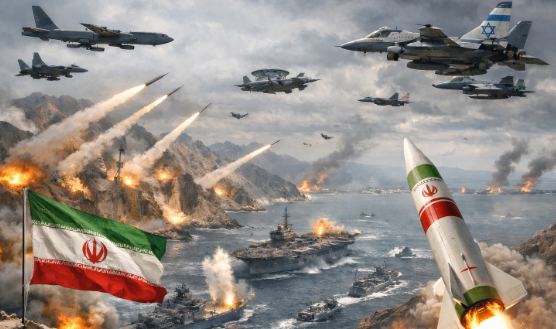
What are Iran’s chances of survival in the face of the American-Israeli armada?
Iran’s survival in the face of the US-Israeli armada is uncertain, depending on various military, political, economic and diplomatic factors.
WHY READ:
- Analysis of Iran’s military capabilities against its aggressors.
- Impact of American and Israeli political decisions on the conflict.
- Economic and diplomatic consequences of the current war.
On the sixth day of a war which saw the participation of a third of the American naval air potential deployed abroad, the resilience of Iran, despite being deprived of an air defense of the territory worthy of the name, is a miracle. And no one can accurately predict the outcome of the war as several decisive parameters remain unknown or subject to unforeseen bifurcations.
The key question that remains is how much can Iran hold up in the face of such intense bombardment without serious air cover capable of making US-Israeli raids costly? The answer to this question depends on the evolution of several military, political, economic and diplomatic parameters.
On the military level:
1.the absolute superiority of the Americans and Israelis in the sky alone should not assure them a victory within a reasonable period of two to three weeks. To force Iran to capitulate or cause the collapse of the regime, the aggressors have no other choice than to consider a ground intervention whose cost exceeds the gains expected by the American Administration even if their Israeli allies do not despair of pushing them in this direction.
2.Time is on the side of Iran and against its aggressors. The longer the war lasts, the more the aggressors risk running out of ammunition, especially intelligent ammunition.
3.Geography greatly serves Iran, which has been able to exploit it to its advantage by basing its entire dissuasive strategy on underground bases and factories buried in the difficult-to-reach mountains.
4.Iran had the intelligence to strike from the first days the American bases in the region by primarily targeting the early warning systems and the radars of the Patriot and Thaad anti-aircraft systems, which helped to partially blind the aggressors and reduce the impact of their sorties.
On the political level:
1.Before launching their aggression, the Americans and Israelis launched a hybrid war against Iran in which support for popular protests against inflation went hand in hand with clandestine action by Mossad, CIA and MI5 agents (terrorist attacks, electronic and information warfare). Even weakened by repression, the Iranian opposition capable of playing the role of backup on behalf of the Americans and Israelis is still there but the American-Israeli aggression and the assassination of the supreme guide Ayatollah Ali Khamenei provoked a nationalist shock wave and a sacred union that the Iranian regime did not hesitate to use in its mobilization against the aggression.
2.On the internal level, the Trump Administration will not be able to hide its distress in the face of Iranian resilience for long, despite triumphalist rhetoric that does not deceive observers. Trump is already convinced that his sidekick in this adventure Netanyahu deceived him by promising a quick outcome and a collapse of the regime in the aftermath of the assassination of supreme guide Ali Khamenei.
Trump will not sacrifice the mid-term elections and his sordid financial calculations on the altar of his loyalty to Israel and will try to get out of it as usual by a pirouette by claiming as last June that he has destroyed Iranian military capabilities and that Iran no longer poses any threat to the region.
Netanyahu is aware of this scenario and fears it above all else. This is why it seeks to drag the countries of the region into open war against Iran to close any exit route to its American ally.
On the economic level:
By decreeing the closure of the Strait of Hormuz, by attacking some strategic energy objectives and by threatening to go further in this direction, Iran has already seriously impacted oil and gas prices on a global scale. If he manages to transform the conflict into a war of attrition and he has the means, the prospects for the world (and particularly European) economy will be unbearable and will push these countries to press for a rapid ceasefire.
On the diplomatic level:
1.The war launched by the United States and Israel against Iran is far from benefiting from the consensus of other international powers. Even if Europeans would not take a dim view of the disappearance of the Iranian regime, the economic bill risks being ruinous for them.
If Russia and China do not have the means to put an immediate end to this war, they welcome the gradual exhaustion of American munitions (to which they may have contributed through the satellite intelligence provided to the Iranians) and will not hesitate to raise their voices as the Americans get bogged down.
All these countries will not take any risk to save Iran’s skin, but they will not hesitate to take advantage of the slightest American setback to push in the direction of stopping a war from which they fear a drift into the unknown.
2.But the most important parameter on the diplomatic level is the fact that Washington and Tel Aviv do not necessarily have the same strategic interests in this war. For Israeli hawks, the destruction of Iran is a quasi-existential question. They will do everything to push their American ally to the worst, just as they tricked him into entering this war.
On the other hand, for the United States, Iran does not constitute a strategic threat and they can be satisfied with its relative weakening to get it to negotiate a deal favorable to US interests in the region, especially since it could always constitute a scarecrow to blackmail the Gulf petromonarchies who are already ordered to pay the bill for the renewal of the air defense systems destroyed by Iran.
