
What Should Men Wear for Hajj or Umrah? Practical Clothing Advice for Brothers
Every year, as soon as the Hajj and Umrah season approaches, the same questions flood the brothers’ WhatsApp groups and Facebook pages: « After ihram, what should I wear that won’t make me melt in the heat? » « Which thobe is the most comfortable for long days of worship? » « Where can I find something that actually lasts the whole trip? »
After following these conversations for years and seeing what thousands of pilgrims actually choose, the answer has become very clear: more and more brothers are turning to the Moroccan thobe.
1. Ihram – Two white sheets and nothing more
The rules have never changed and never will:
- Two plain, unstitched white pieces of cloth (izar + rida)
- Simple open sandals (rubber or leather)
Practical tip that saves a lot of discomfort: avoid the very thin ihram towels sold for a few riyals. After the first wudu they become almost transparent and feel rough on the skin. Spend a little more on medium-weight cotton, you’ll thank yourself after the tenth tawaf.
2. Once you exit ihram: the garment that has quietly taken over
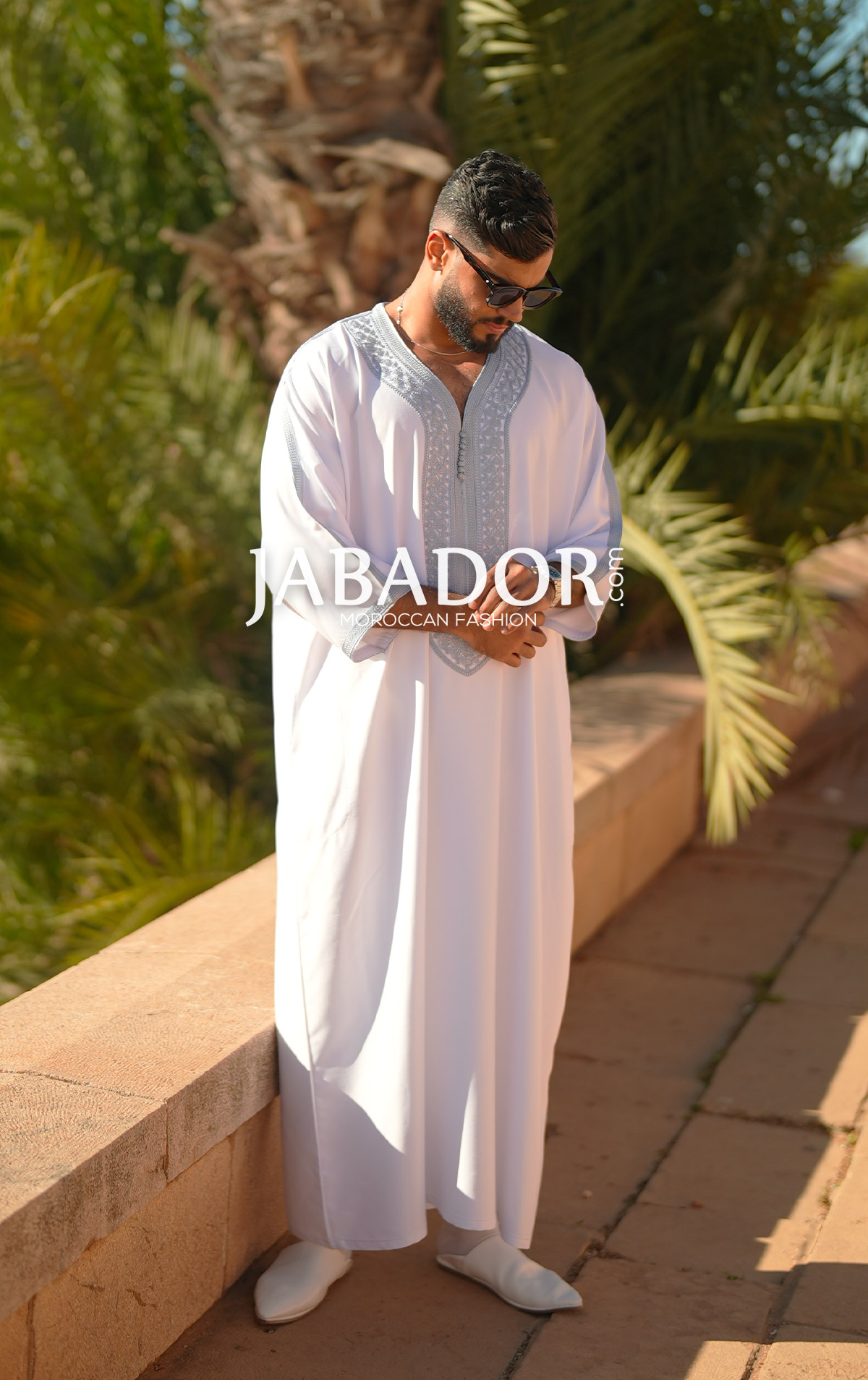
Five or six years ago, the vast majority of pilgrims wore classic Saudi or Emirati thobes. Today, walk around the Kaaba at Maghrib or pray in the courtyard of the Prophet’s Mosque (peace and blessings be upon him) and you will see a very different picture: a huge number of brothers, from Indonesia to France, from Canada to United States are wearing the lighter, wider Moroccan thobe (also called Moroccan Gandoura).
The reasons are purely practical:
- The fabric (often linen, gabardine or high-quality cotton blend) breathes far better than most classic thobes and stays cool even in direct midday sun.
- The cut is deliberately generous in the shoulders, chest and sleeves, giving complete freedom when raising your hands in duÊ¿Äʾ, doing long sujood or walking quickly between Safa and Marwah.
- The length reaches mid-calf or ankle and stays there when you sit cross-legged on the marble, essential when the floor is burning hot.
- It dries almost instantly after wudu, a detail that matters when you make ablutions 10–15 times a day.
- The fabric is crease-resistant and the colours don’t fade, so it still looks respectable on the last day of your trip.
- The embroidery is subtle and tasteful: either very discreet or traditional Moroccan passementerie that adds elegance without ever being ostentatious.
In short, it was designed for comfort and modesty in a hot climate, exactly what a pilgrim needs.
3. Where to buy a real Moroccan thobe (avoid the cheap copies)
Unfortunately, the success of the Moroccan thobe has created a flood of very low-cost imitations, often made in China or Bangladesh, sold on marketplaces with “Moroccan style” in the title. The fabric is thin, the stitching comes apart after two washes, and the cut has nothing Moroccan about it.
If you want the authentic version, the one you actually see on thousands of brothers in Makkah and Madinah, look for brands that still manufacture entirely in Morocco with local fabrics and traditional know-how.
One of the names that comes up most often in pilgrim groups and forums is Jabador.com. Everything is made in their workshops in Morocco, the embroidery is done by hand or on traditional machines, the fabrics are carefully chosen (breathable linen, durable gabardine or premium cotton), and the cut is the real generous Moroccan cut that pilgrims love.
→ Moroccan Thobe collection (the one most brothers buy): https://www.jabador.com/en/store/moroccan-thobe/
→ Full English shop (all colours, sizes and other models): https://www.jabador.com/en
4. Minimalist packing list that works every time
- 2 complete ihram sets (medium thickness)
- 2 or 3 Moroccan thobes in very light colours (white + beige or light grey)
- 1 pair of soft leather socks for inside the mosques
- 1 small foldable prayer mat
- Unscented sunscreen and petroleum jelly (vaseline) for lips and nose
- Small cross-body bag for phone, hotel card and a few riyals
That’s literally all most seasoned pilgrims travel with.
May Allah accept your Hajj or Umrah, grant you perfect health, make every step easy and every duÊ¿Äʾ answered, and allow you to pray two rakÊ¿ahs in the Rawdah with khushuÊ¿.
Any question about fabrics, colours, sizing or preparation — leave a comment, I answer everyone.
Safe travels and see you very soon in the holy cities, insha’Allah ðŸ¤
