
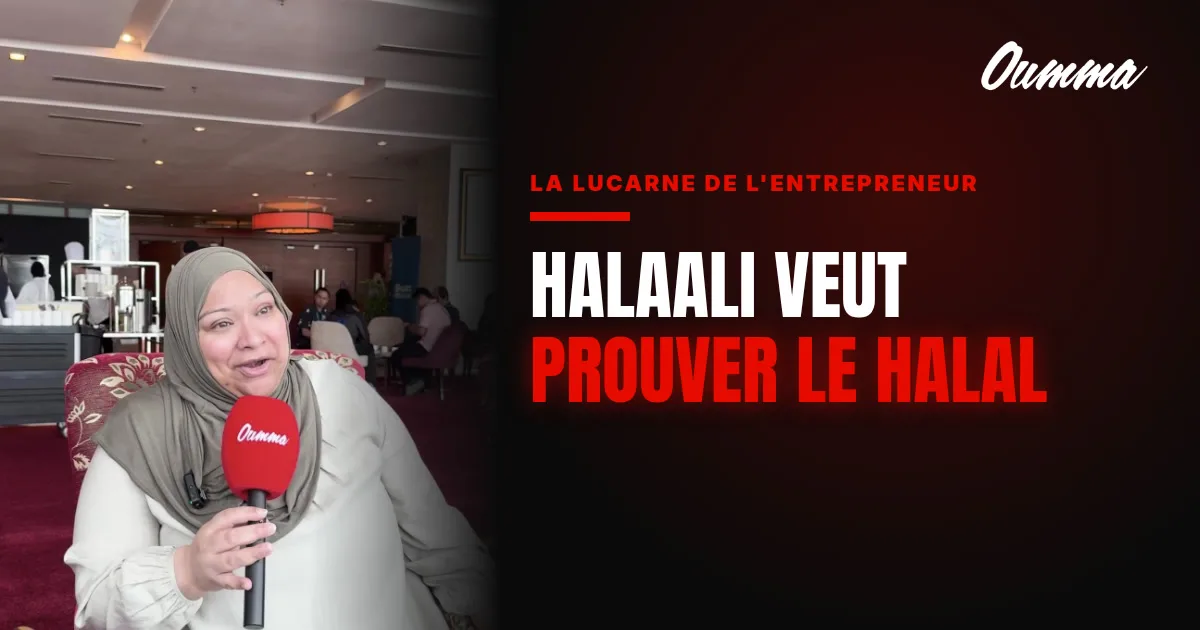
Halaali, the app that requests the certificate
“We were looking for halal restaurants to eat at. At each restaurant, we were told: “yes, it’s halal”. But as soon as we asked for proof, they couldn’t show anything. » Aisha Ismail recounts the birth of Halaali through a scene that many traveling Muslims have experienced. It was in Mauritius a year ago. To the restaurateur who replied “my sister, I am Muslim, don’t you trust me?” », she would have wanted to ask for only one thing: the certificate.
Co-founder and director of operations of the application, based in Ontario, Canada, she was in Kuantan, Malaysia, for the 5e World Islamic Tourism Conference (WITC 2026), November 5-6. Oumma was invited there and met her to The Entrepreneur’s Skylight. She leaves impressed by the variety of topics covered, from families to women traveling alone, and regrets that such a meeting does not exist in the West, where everyone, she says, believes they have to “blend into the mold”.
From restaurant to “super app”
Halaali was first a directory of halal restaurants, then a tool for finding mosques while traveling. A trip to Malaysia this year expanded the project. “There is so much halal here, but nothing is there for the Muslim traveler,” summarizes Aisha Ismail. Today she describes an ecosystem “from cradle to grave”: you choose a destination, and the application indicates how to apply for your visa, where to buy food and which organizations certify halal on site.
On its site, Halaali presents itself as a Muslim “super app”. It already offers restaurants, grocery stores, butchers and mosques, qibla direction, prayer times and a news feed. Other services are announced, including several still marked “soon”: nikah, donations, real estate, health and beauty, legal advice. The company claims more than 4,500 halal places, 4,400 restaurants and 19,000 mosques listed, in four countries.
Trust first, growth second
Halal restaurant applications already exist, our journalist points out. His answer is in the company motto, “ trust before scale »: confidence first, growth second. In other words, don’t try to cover as many countries and addresses as possible if it comes at the cost of accuracy.
“Anyone can create an app, put information in it. I can Google it now, and it will tell me: “Ahmed ate here, it was good, the owner is Muslim, it’s halal.” But when you ask for a certificate, they can’t show it to you. It’s all self-proclaimed. (…) We go directly to the authorities, to the certification body, for information about the app. »
This is the heart of the model. In most directories, the halal status of a restaurant is based on what its owner declares or on customer reviews. Halaali says it draws its data from the certification bodies of each country. In Mauritius, its stated partner is the Jamiat-Ul-Ulama, the island’s religious body. In Canada, the app added Ontario restaurants certified by the Halal Monitoring Authority (HMA) in January.
The promise has its limits, and the site recognizes them: for butchers, the certifier and the slaughter method are only indicated “where we have them”. A referenced place is therefore not always a certified place. Proven halal remains an objective, which the application approaches country by country, in step with the data obtained from certifiers. Aisha Ismail admits: gathering this data is “the hardest part”. “We don’t want to put anything there that isn’t accurate, because it’s a huge responsibility that we have taken on ourselves. »
A company of four people
Behind the application, a family affair. “Halaali is a team of four,” explains its co-founder: herself; her husband Yacoob, CEO and financial director, accountant by training; Abdul Moiz, technical director; and their daughter Soumaiya, marketing manager, who knows the Koran by heart. “The four of us do everything. Jack of all trades, experts in none, of course, but al-hamdoulillah, it works. »
To cover new countries without expanding the team, Halaali recruits “ambassadors” paid on commission. They publicize the application and report local data, which the team then integrates. Free to download, the application also displays advertisements and offers in-app purchases, according to its Google Play sheet.
Mauritius, Canada, then Malaysia
Halaali is launched in Mauritius, and the team prepares for Canada. The day before the interview, she signed a memorandum of understanding with the Islamic Tourism Centre, the body of the Malaysian Ministry of Tourism which organized the conference, to integrate halal travel and restaurants in the country into the app. “The app is already functional in each country,” assures Aisha Ismail. You just need to provide it with the right data. »
The French-speaking world is on the list. The company is looking for partners there and thinks it “has found one”. The launch will wait until the data from the certifiers is gathered.
There remains the gap between the ambition and the actual size: four people, four countries, a little over a thousand downloads on Android. Halaali is betting that, in a market already crowded with directories, the reliability of information will matter more than the number of addresses. Its co-founder ends with an invitation: “Download the app, take a look. If there is something missing in a country, tell us. »
Interview carried out by Oumma at the 5e World Islamic Tourism Conference (WITC 2026), in Kuantan, Malaysia, for Oumma TV’s La Lucarne de l’entrepreneur show. Figures and features: Halaali official website and Google Play profile of the application.
