Leading with your values: Islamic finance
Create your business, finance it, grow your savings, manage it, then pass it on: all this, without renouncing your convictions. This was the thread of the conference “Leading with your values, ethical journey & Islamic finance”, organized on Saturday October 24, 2026 at the Financia Business School, rue de Lourmel, in the 15th arrondissement of Paris. A plenary and three masterclasses, put together by students of the 8th class of the school’s Islamic Finance Certificate, and reserved for managers, craftsmen, traders, liberal professions and their advisors: accountants, lawyers, notaries, bankers.
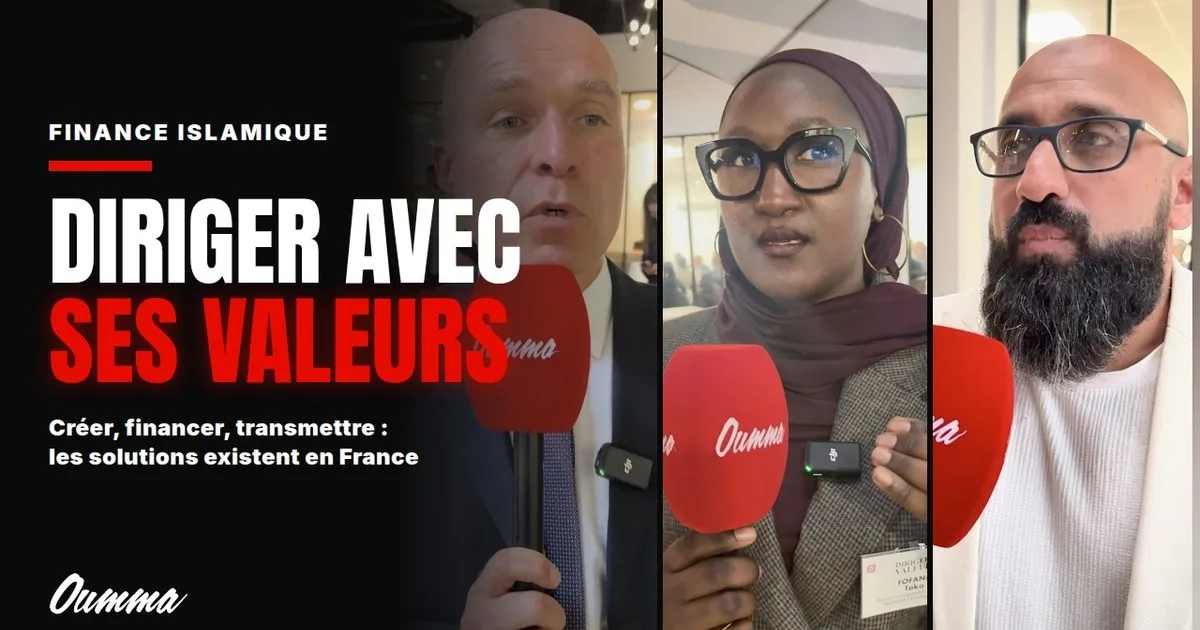
The initial question is contained in one sentence, posed by the organizers: Islamic finance is often approached from the angle of wealth management, “and our leaders in all this? » Oumma handed the microphone to eight speakers. Their common response: solutions exist in France, more numerous than we think, but they remain poorly known, and financing for SMEs is still to be built.
“A market within a market”
Mohamed Mosbahi, wealth management advisor, founded the Amana Patrimoine firm. The idea “matured and hatched almost at Financia”, where he followed his Executive MBA. For him, leading with your values, “that’s what every Muslim entrepreneur must ultimately do.”
He does not overestimate the weight of the sector: Islamic finance is “a market within the market”, a “small part” of conventional finance. But a market which has been developing and expanding “for more than fifteen years”, and to which Muslim professionals want to “participate and contribute”.
Anouar Hassoune, consultant in Islamic finance for twenty-five years after a career in a rating agency and in banking, gives a definition. Finance, he recalls, is “a perfectly amoral sector of activity. That doesn’t mean he’s immoral: it means he doesn’t care about morality. » Islamic finance is “a compartment of ethical finance”: it must respect precise principles.
- no interest;
- no speculation;
- no illicit sectors of activity;
- sharing profits and losses with its stakeholders.
In short, “a compartment of finance which tends to do good”.
What a Muslim leader can already do in France
Baghdad Chijii co-founded the Abtal firm, a multi-family office which supports high-level athletes and business leaders in wealth management consistent with Muslim ethics. An “above all universal” ethic, to which are added rules of conformity with Muslim law.
Ten years ago, he notes, there did not exist “a lot of solutions”. Today, a French Muslim can:
- finance the purchase of your main residence, a rental investment or your business premises;
- invest in all asset classes: real estate in France or abroad, Islamic financial markets, investment funds;
- use tax envelopes that give the right to tax advantages, “in a French context, this is important”;
- place part of your savings in alternative investments that directly support entrepreneurs, “and therefore the real economy”.
For a business manager, the method begins with a diagnosis of his personal and professional situation, his needs and his objectives, then with a long-term wealth strategy. The goal: to build assets “as a good father”, effective with regard to its values as well as law and taxation, and capable of producing an income. So that, “if tomorrow the entrepreneurial adventure ends for this business leader, his patrimonial adventure continues”.
Transmit according to its values, in compliance with French law
Salima Dahmani is an associated notary in Montmorency, in Val-d’Oise. She came to “alert” business leaders to a point that is often neglected: to anticipate, to pass on and perpetuate your business. Marriage contracts, donations, company creations, inheritances, real estate purchases: the notary supports his clients “throughout their lives”.
For her, Islamic finance is “the common thread” of community life: applying religious rules on a daily basis, in one’s work and projects. Concretely, this can take the form of wills drawn up in accordance with Islamic law while respecting French rules, or devices such as forward payment for a real estate purchase.
The notary, she summarizes, “does with the tools he has” and adapts them to the situation of each client. “If the particularity is to respect values and ethics, well we will do so, while respecting French laws. »
Sakina: funeral insurance with more than 5,000 members
Ezzedine Ghlamallah has been teaching at Financia Business School for five years. He manages SAAFI, a financial investment consulting and insurance brokerage firm, which launched Sakina in 2020, a pension solution designed on the model of takaful, Islamic mutual insurance.
Sakina Funérailles finances the funerals and the repatriation of bodies to the countries of origin of the Muslim diasporas in France. Today it has “a little more than five thousand members”, from all communities: Moroccan, Algerian, Senegalese, Malian, Yemeni… Converts also subscribe, to finance not a repatriation but a burial in France.
His observation echoes that of the other speakers: no actor alone meets all the needs. A multitude of players each provide a solution, “from real estate financing to savings, including funeral planning”.
London’s view: “Create universal products”
Guest of honor of the evening, Omar Khaliel heads the Riba Free Foundation, a British charity which helps individuals live interest-free lives: financial education, advocacy with communities and Parliament, guidance towards riba-free products. He had come to deliver the graduation speech, at the invitation of “(his) dear brother” Kader Merbouh, who has been teaching Islamic finance for thirteen to fifteen years. More than a hundred students, former, current and future, were present, and more than twenty-five received their certificate or Executive MBA in Islamic finance.
The United Kingdom is “the most Western market for Islamic finance in the world”, where it has existed “for thirty, almost forty years”. Today it has five Islamic banks, two or three Islamic “windows” backed by conventional banks, and more than twenty fintechs which offer automobile financing, real estate financing, stock investments or insurance. France is “at the beginning”: a very large Muslim community, but not yet the infrastructure or the products.
Not yet, he insists. According to him, France could “explode” on this market in the next five to ten years, by learning British lessons, those of successes and failures: “You will learn from our mistakes much more quickly”, especially since France has, he says, “twice as much population”. One of the United Kingdom’s failures, he recognizes, is not having been able to explain to the general public what Islamic finance really brings.
Hence his main advice: do not design products “just for Muslims”. “Create universal products that solve societal problems and are commercially viable for everyone. Then people will understand the true value of Islamic finance,” which is to ensure that the real economy coincides with the moral economy.
Undertake to emancipate yourself
Tako Fofana, an accountant specializing in corporate group taxation, created the accounting and tax firm Mansa Consulting four years ago. She supports managers to “secure” their company, but above all so that they achieve the objectives set by their vision.
Her firm is based on values that she has chosen, which are also those of Islamic finance, and on an entire ecosystem that respects them. With a strong idea: emancipation. She created her company to bring her own vision of the profession of accountant, but also because “entrepreneurship is a means of emancipation”. The question then becomes: “how do we emancipate ourselves by being ourselves”.
What exists, what is still missing
Does French Islamic finance cover all the needs of Muslims in France? “Far from it,” replies Anouar Hassoune. Banking offers exist, especially for individuals (the purchase of a main residence in particular) and for savings; much less for entrepreneurs. The afternoon masterclasses therefore had to answer three questions: what is the current state of the products? What do entrepreneurs need, in financing, in savings, in advice? And how can wealth management advisors, brokers and investors converge “on the same platform”?
He does not hide the obstacle: the context of continental Europe is “much more closed, much more restrictive, much more ideological than in the United Kingdom”. “The English show us the way, yes, but they have had facilitations at an institutional level that we will not have. It takes creativity and, for some of us, genius, I hope. »
Kader Merbouh, director of the Islamic finance department at Financia Business School, takes stock of the day. Business financing is “starting to become structured”: there are tailor-made solutions, but “we have not yet managed to industrialize financing solutions for SMEs”. For savings, on the other hand, the offers are “increasingly” numerous, as demonstrated by the wealth managers and management companies present that day.
And the comparison with London is not so cruel: “Our London friends tell us that we absolutely have nothing to be ashamed of the offer between England and France. » The real problem lies elsewhere: “People don’t think about it, and some don’t even believe in it. » The demonstration of the conference, he concludes, is that at each stage, transmission, savings and financing, there are solutions and more and more experts to support: accounting firms, notaries, lawyers, wealth management advisors.
Oumma video report, filmed on October 24, 2026 at the Financia Business School (Paris). Omar Khaliel’s remarks, spoken in English, are translated by the editorial staff.
